



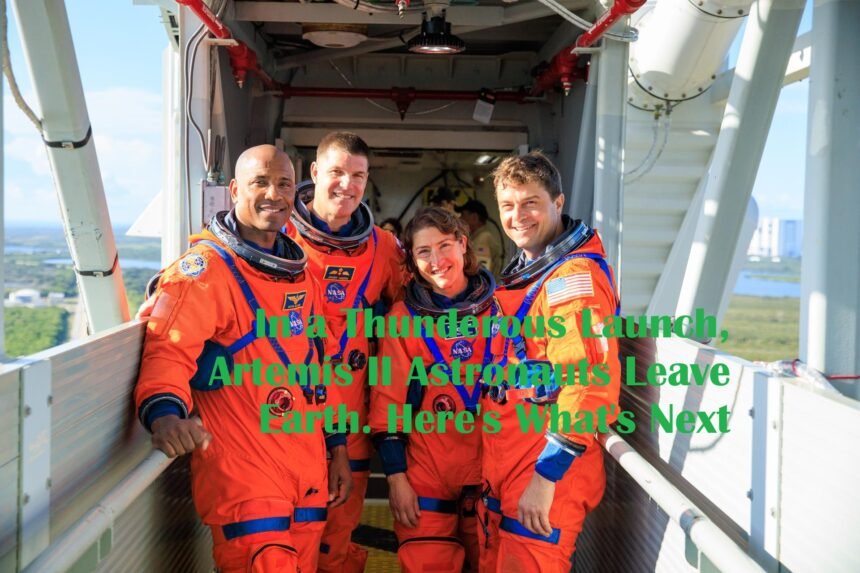
In a historic moment for space exploration, the Artemis II mission successfully lifted off from Earth, marking the next major milestone in NASA’s Artemis program. The launch occurred under a sky filled with anticipation, as astronauts embarked on a journey that aims to push the boundaries of human spaceflight.
The Launch Event
The spacecraft’s ascent was a spectacle of engineering and precision. With engines roaring, the Artemis II crew was propelled into orbit, leaving the familiar confines of Earth behind. Millions of people watched the launch live, captivated by the dramatic display of technology and human ambition.
The mission’s success represents years of preparation, planning, and testing. Each component of the spacecraft, from the booster rockets to the life-support systems, had undergone rigorous evaluation before launch.
Mission Objectives
Artemis II carries a crewed spacecraft on a path around the Moon, without landing. This mission will validate systems, procedures, and operations necessary for future lunar missions. It is the first crewed flight in the Artemis program, following Artemis I, which was an uncrewed test flight.
Astronauts onboard will experience deep space conditions and test spacecraft performance in a real mission scenario. Key goals include testing communication systems, monitoring astronaut health in deep space, and validating navigation around the Moon.
Data collected from this mission will inform the planning of Artemis III, which aims to land astronauts on the lunar surface. The mission also serves to strengthen international collaboration in space exploration.
Crew Experience and Safety
The Artemis II crew is composed of highly trained astronauts with extensive experience in space operations. They have undergone rigorous simulations, emergency drills, and physical conditioning to prepare for the journey. Safety remains a top priority, and mission control continuously monitors spacecraft systems and crew well-being.
Astronauts are expected to spend several days orbiting the Moon. During this time, they will perform system checks, conduct scientific observations, and communicate with mission control on Earth. These activities are crucial to ensure that future missions can operate safely and effectively in the harsh environment of space.
Technological Innovations
The Artemis II spacecraft incorporates several technological advancements designed to support long-duration missions. Life-support systems have been upgraded to maintain crew health, including improved air and water recycling technologies.
Navigation systems utilize the latest guidance algorithms to ensure a precise trajectory around the Moon. In addition, communication systems have been enhanced to provide continuous contact with Earth, even during the far side of the Moon’s orbit.
The launch vehicle, a powerful rocket designed specifically for deep-space missions, demonstrated the ability to deliver heavy payloads beyond low Earth orbit. This capability is essential for carrying larger spacecraft, supplies, and equipment for extended missions, including future lunar bases.
Scientific Contributions
Although Artemis II is not primarily a scientific mission, it offers valuable opportunities for research. Instruments onboard will monitor space radiation, test new sensors, and gather data on microgravity effects.
These findings will contribute to understanding how humans can safely live and work in space for longer periods. Observations of the Moon’s surface from orbit will also provide high-resolution imagery to aid in selecting future landing sites.
Additionally, the mission allows engineers and scientists to refine models of spacecraft performance, crew health management, and space communication systems. Every successful maneuver and system check enhances knowledge that will benefit both Artemis III and subsequent missions to the Moon and beyond.
Global Significance
The Artemis II launch is a symbol of human ambition and international cooperation. Countries and space agencies around the world are watching closely, recognizing the mission as a milestone in humanity’s return to the Moon. Collaboration on technology, research, and safety protocols strengthens global partnerships and encourages shared progress in space exploration.
Beyond its technical and scientific importance, Artemis II inspires the next generation of scientists, engineers, and explorers. The visibility of the mission has generated excitement among students, educators, and the general public. Many young people are motivated to pursue careers in STEM fields, driven by the spectacle and achievements of spaceflight.
Next Steps for Artemis
Following the successful orbit around the Moon, the spacecraft will begin its return journey to Earth. Re-entry and landing procedures will test the spacecraft’s ability to safely bring astronauts home. Upon splashdown, the crew will be retrieved and undergo post-mission evaluations to assess health and mission impact.
The results from Artemis II will directly influence planning for Artemis III, the mission intended to land astronauts on the lunar surface.
Engineers and mission planners will use the data collected to refine spacecraft systems, ensure astronaut safety, and optimize mission schedules. Artemis III will focus on establishing a sustainable presence on the Moon, with long-term goals including lunar bases and resource utilization.
Challenges Ahead
While Artemis II has been successful, future missions face significant challenges. Deep space presents risks from radiation, microgravity, and equipment reliability. Long-duration missions require continuous improvements in life-support systems, energy management, and emergency protocols.
The Artemis program is designed to address these challenges through incremental testing, iterative improvements, and careful planning. The lessons learned from Artemis II will be crucial in reducing risks for astronauts on subsequent missions.
Continuous monitoring, research, and technological development will support the vision of sustainable human exploration of the Moon and, eventually, Mars.
A Milestone for Humanity
Artemis II represents more than just a mission; it is a milestone in the story of human exploration. The successful launch and lunar orbit demonstrate the potential of technology, teamwork, and perseverance. Each stage of the mission provides critical insights that pave the way for future achievements in space.
As the Artemis program continues, humanity moves closer to a permanent presence beyond Earth. The mission inspires wonder, curiosity, and determination, reminding us of the boundless possibilities of exploration. From this point onward, the Artemis II crew carries not only scientific instruments but also the aspirations of millions who dream of the stars.