



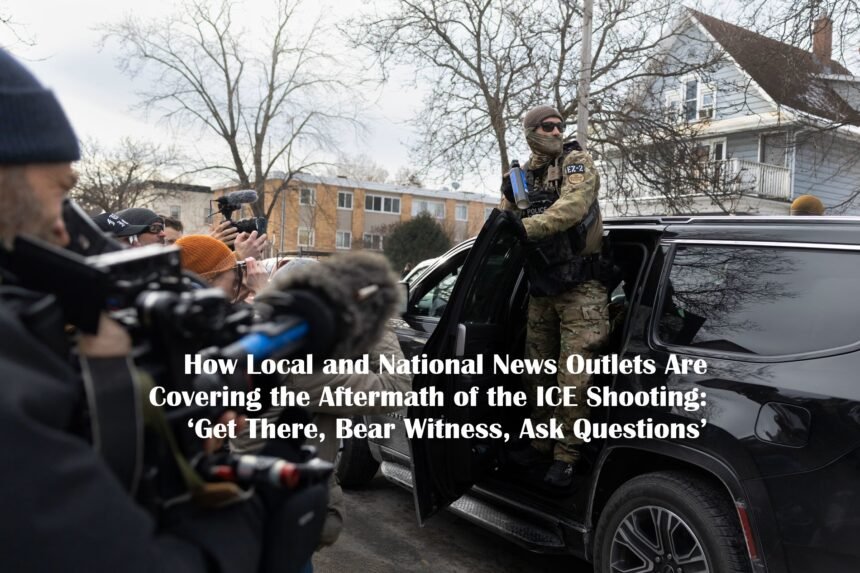
The fatal shooting involving a federal immigration agent in a U.S. city has dominated news coverage. Journalists from both local and national outlets have reported continuously on the incident and its aftermath. Their reporting has reflected intense public interest, political conflict, and widely differing interpretations of the events.
This article examines how the media has shaped understanding of the shooting, how reporters have responded on the ground, and what coverage reveals about the role of modern journalism in volatile situations.
Immediate Response by Local Media
Local news organizations were among the first to arrive at the scene and provide detailed accounts of the incident. Outlets such as community newspapers and radio stations quickly gathered eyewitness testimony, footage from residents, and updates from local officials. Many described chaotic scenes that unfolded immediately after gunfire was heard in a residential neighborhood.
Protesters gathered, and bystanders shared videos and photos that circulated online. Minnesota-based reporters provided context that national outlets could not easily match. These journalists explained the layout of the streets, interviewed neighbors who witnessed the incident, and described how the community reacted in real-time.
They also reported on how the presence of federal agents affected daily life before and after the shooting. Coverage from local radio and newspapers highlighted school closures, neighborhood tensions, and varying accounts of what had triggered the deadly encounter. One notable local newspaper identified the federal agent involved before many national outlets did.
The decision to name the officer sparked debate. Federal authorities had pressured media not to release this information, arguing that identification could endanger ongoing investigations. Despite the pushback, the local newsroom published the name, citing its role in ensuring accountability.
National Outlets and Broader Context
National news organizations also mobilized quickly. Major television networks and large news websites dispatched reporters and camera crews to the city. Their coverage often emphasized legal and political dimensions.
These outlets interviewed federal officials, national civil rights advocates, and immigration policy experts. In doing so, they placed the shooting within wider debates on immigration enforcement and civil liberties. National reporters asked key questions about the justification for the shooting, federal policies guiding ICE, and the role of the Department of Homeland Security.
They also noted how the event fit into trends seen in other cities where federal agents have conducted aggressive operations. By presenting these broader frameworks, national media provided readers and viewers with analytical lenses that went beyond immediate eyewitness accounts.
While local outlets shared scenes from the streets, national coverage drew attention to political reactions. Statements made by government officials, calls for investigations, and disputes between political parties were highlighted prominently.
Civil liberties organizations’ demands for transparency were also featured. This mix of political analysis and on-the-ground reporting illustrated how the national press attempted to balance immediacy with context.
The Importance of Firsthand Reporting
Across many stories, journalists stressed the value of being present at the scene. Some reporters echoed a familiar mantra: “Get there, bear witness, ask questions.” This approach underscored a commitment to firsthand information rather than purely secondhand reports.
Correspondents stood at protest sites, observed law enforcement interactions, and recorded the voices of people directly affected by the shooting and its fallout. Local stations broadcast live as demonstrations expanded. Footage showed crowds of protesters chanting and marching through city streets.
Reporters spoke with relatives of the victim, neighbors concerned about safety, and activists calling for accountability. These interviews helped paint a multi-dimensional picture of how the community was coping and responding. Some national media crews, although less familiar with local geography, offered wide-angle coverage showing how protests spread to other cities.
They also highlighted rallies in multiple states, connecting local anger to nationwide criticism of federal immigration policies. Such coverage demonstrated that the impact of the shooting was felt far beyond the immediate neighborhood.
Conflicting Narratives and Media Challenges
A major challenge for both local and national news outlets was presenting a coherent narrative amid conflicting accounts. Federal officials described the incident as an act of self-defense by the agent. In contrast, many local witnesses and community leaders disputed that claim, saying video evidence did not clearly show a threat to officers.
These conflicting narratives forced journalists to navigate carefully between official statements and community testimony. Some outlets faced intense scrutiny from the public. Social media users accused certain news organizations of bias. They claimed that some broadcasters chose to highlight footage or angles that supported one interpretation over another.
This criticism reflected a broader skepticism about mainstream media and raised questions about how newsrooms make editorial decisions during fast-moving events. Despite these challenges, many reporters sought to verify claims rigorously. They compared multiple videos, consulted legal experts, and noted discrepancies in official accounts.
Some journalists acknowledged that video alone can be misleading, especially when viewers come to the footage with preexisting beliefs. The varied interpretations underscored journalism’s complex role in a polarized information environment.
Political and Legal Implications in Coverage
News coverage did not shy away from exploring political consequences. Federal leaders defended immigration enforcement actions, while local politicians called for investigations into how the situation was handled. National reporting highlighted these clashes, often bringing in analysis from political scientists and legal scholars.
Some articles noted that disputes over investigative authority complicated the story. For example, federal officials resisted state-led inquiries, asserting that national law enforcement had jurisdiction.
Local leaders argued that transparency was necessary, especially given the fatal outcome. Journalists explained these tensions clearly so readers could understand why the story extended beyond the streets and into courtrooms and legislative bodies.
Sustained Attention and the Future of Coverage
As protests continued and public interest remained high, newsrooms signaled that coverage would be ongoing. Local journalists planned follow-ups on community impact, how law enforcement strategy might change, and what reforms might be called for. National outlets indicated continued reporting on political ramifications and national responses.
What remains clear is that the media’s approach combined immediacy, context, and investigation. Local reporters delivered direct observation and community insight, while national outlets provided scale and political framing. Together, this coverage aimed to inform audiences comprehensively in a situation filled with tension and controversy.