


The government of Honduras has moved decisively to reactivate charges against a former leader, just days after his controversial release from a U.S. prison. The decision has thrust the Central American country into fresh political and legal turmoil.
A Pardon Sparks Renewed Legal Action
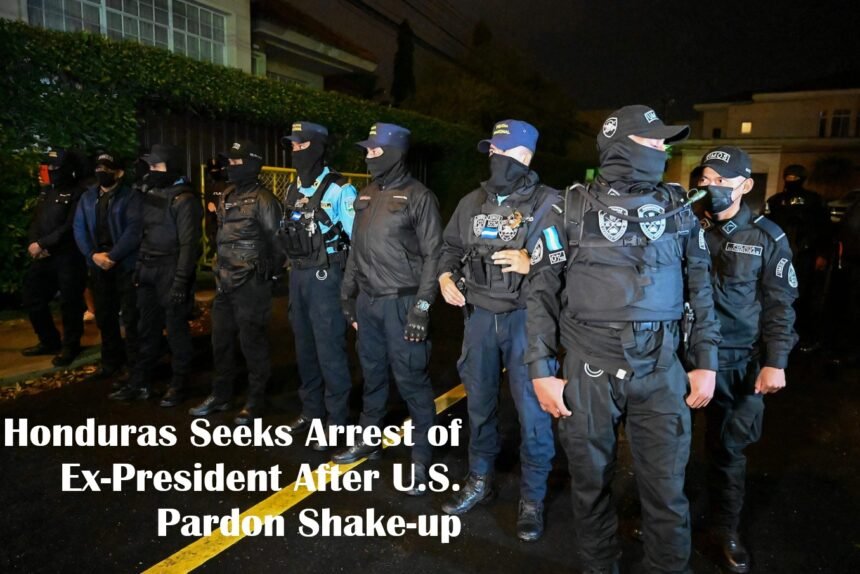
On December 8, 2025, the Attorney General of Honduras, Johel Zelaya, requested that both national authorities and INTERPOL execute a 2023 arrest warrant for the former president, Juan Orlando Hernández. The warrant had been issued as part of a corruption investigation, but its enforcement was conditioned on the ex-president’s release from U.S. custody, a condition that was recently met after a pardon.
Hernández had been serving a 45-year prison sentence in the United States for drug trafficking and weapons-related offenses. His release followed a full pardon granted by former U.S. President Donald J. Trump. The pardon reignited criticism and triggered a reassessment of remaining legal cases against him in Honduras.
Charges in Honduras: Fraud and Money Laundering
The renewed arrest order does not relate to the U.S. drug trafficking conviction. Instead, it refers to alleged crimes of fraud and money laundering that date back to a domestic scandal known as the Pandora case. Prosecutors claim that public funds were diverted through nongovernmental organizations and channeled into political campaigns, including Hernández’s 2013 run for office.
According to the Attorney General’s office, dozens of former officials and politicians were implicated in that case. The order had been signed in 2023 but was held in abeyance pending any developments in the U.S. sentence. Once the pardon was issued, the legal mechanism was reactivated.
A Pardon Contested Both at Home and Abroad
The pardon had provoked immediate outrage in many quarters. Critics argued that granting clemency to a former head of state convicted of drug trafficking dealt a blow both to justice and to anti-narcotics efforts. Among them was the United States Department of Justice, which had characterized Hernández’s actions as facilitating one of the largest and most violent drug-trafficking conspiracies in history.
Inside Honduras, the pardon also stirred deep controversy because the timing coincided with a presidential election. The decision raised concerns that foreign influence and political calculations played a role. Many Hondurans were shocked that a man convicted in a high-profile U.S. trial could be released so abruptly.
Supporters of Hernández, however, welcomed the pardon. They echoed the argument by Trump that the prosecution had been unfair and politically motivated, a narrative Hernández himself reiterated after his release.
Meanwhile, the government under which Hernández was originally extradited, led by the party of current President Xiomara Castro, denied any political motivations behind the arrest request. According to officials, the renewed warrant reflects a genuine desire to end impunity and hold former leaders accountable under domestic law.
Uncertain Whereabouts, Rising Tensions
At the moment, Hernández’s whereabouts are kept confidential, reportedly for security reasons. His wife confirmed that he remains in an undisclosed “safe location,” though she declined to reveal his exact location or future plans. Observers warn that any attempt to return him to Honduras under the potential risk of arrest could trigger unrest.
The political environment is already tense, given the contested election and deep polarisation. Many fear that further moves could fuel social division, undermine public trust in institutions, and destabilize the electoral process.
Legal and Political Implications
The latest development underscores that a pardon, even one granted by a foreign power, does not automatically erase all legal risks for a former leader. Domestic jurisdictions may still pursue outstanding cases, especially those involving corruption, fraud, or misuse of public funds.
In this instance, the arrest warrant related to alleged financial crimes remains active and, under Honduran law enforceable once the condition set in 2023 is met. For Honduras, the case serves as a litmus test for the rule of law and accountability.
The move signals to both domestic and international audiences that corruption and illicit enrichment will not be tolerated, regardless of rank or former status. The government’s willingness to revive cases may be intended as a show of resolve against political impunity.
Yet, carrying out these arrests promises to be difficult. With uncertainty surrounding Hernández’s location and potential international protections, authorities may face challenges executing the warrant. The call to INTERPOL suggests that Honduras is preparing for such obstacles.
A Nation Watching Closely
Hondurans await further developments with caution. Many hope that justice will be upheld, but others fear that the arrest bid could be used to settle political scores. The timing, so close to elections, has generated suspicions and deepened mistrust.
At stake is more than the fate of one man. The outcome may shape public perception of the country’s commitment to transparency, the strength of its institutions, and its resolve against corruption. For a nation grappling with decades of political scandals, the renewed arrest order could mark either a turning point or deepen divisions if it is perceived as selective justice.
In the coming weeks, international law enforcement cooperation, judicial follow-through, and political developments inside Honduras will determine whether the arrest warrant becomes a reality or fades into another chapter of legal and political uncertainty.