


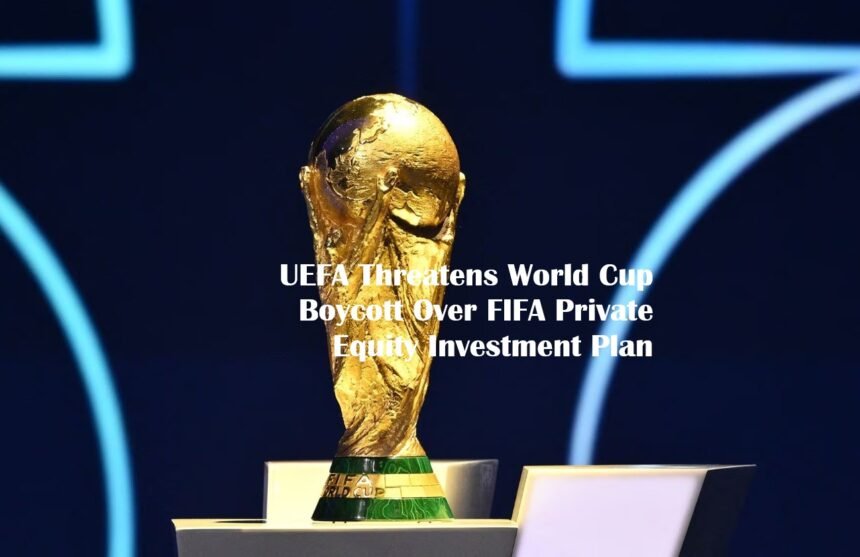
A major political rift is shaking world football as the European governing body, UEFA, threatens to boycott future FIFA World Cup tournaments. UEFA leaders oppose a controversial proposal by FIFA to sell a stake in its media and commercial rights to private equity firms. This growing conflict threatens to disrupt the international football calendar and create an unprecedented power struggle at the highest level of sports governance.
FIFA officials argue that bringing private equity capital into global football will fund grassroots infrastructure and modernize competition formats worldwide. However, European football executives view the strategy as a dangerous commercialization of the sport’s premier international tournament. UEFA claims that private equity involvement risks compromising the traditional integrity, scheduling flexibility, and governance standards of international football.
European Leaders Unite Against Private Equity Expansion
UEFA President Aleksander Čeferin and top European club executives expressed deep skepticism regarding long-term private equity involvement in global football governance. European leaders fear that commercial investors will prioritize quarterly financial returns over player welfare and regional competition schedules. UEFA officials maintain that public football institutions must retain absolute authority over tournament administration and the distribution of media rights.
European football generates the majority of global television revenue and hosts the most valuable domestic leagues, including the English Premier League, Spain’s La Liga, and Italy’s Serie A. If UEFA members refuse to participate in future World Cups, the prestige and commercial value of FIFA’s flagship event would decline dramatically. European nations represent a massive share of world football talent, making a potential boycott a catastrophic scenario for global broadcasters.
- Financial Integrity: Preventing commercial funds from dictating match calendars.
- Player Health: Resisting expanded tournament formats that cause physical burnout.
- Broadcasting Control: Protecting regional television rights from international dilution.
- Governance Autonomy: Keeping decision-making power strictly within elected sports bodies.
Tensions Peak Over Expanding International Match Schedules
The dispute over private equity investment arrives amid growing frustration regarding the expanding international football calendar. FIFA recently introduced expanded formats for both the World Cup and the Club World Cup, adding dozens of extra matches to an already crowded schedule.
Player unions and national league managers continuously voice concerns regarding severe fatigue and frequent injury risks. UEFA leaders argue that private equity investors will inevitably push for even more matches, exhibition tours, and streaming paywalls to maximize their returns. This commercial drive places additional strain on elite athletes who already play up to seventy matches per season. National associations across Europe strongly support UEFA’s firm stance against introducing additional profit-driven commercial structures.
- Tournament Expansion: Adding teams and rounds to global FIFA competitions.
- Commercial Pressure: Seeking higher revenue returns for private equity partners.
- Athlete Protests: Player unions demanding workload limits and rest periods.
- League Disruptions: Domestic competitions facing tight scheduling windows.
The Financial Stakes Behind FIFA’s Global Expansion Strategy
FIFA leadership maintains that alternative investment strategies are essential to bridge the financial gap between European football and the rest of the world. Money generated from private equity investments would primarily flow to developing football nations across Africa, Asia, and North America. FIFA believes that equalizing global financial resources will elevate the competitive quality of football worldwide. Despite FIFA’s developmental arguments, UEFA remains unconvinced that private equity firms offer a sustainable long-term solution.
European officials point out that financial debt and aggressive revenue expectations usually accompany private equity deals. UEFA prefers traditional revenue-sharing models that keep financial control within non-profit governing federations rather than external investment firms.
Potential Compromise or Long-Term Division
As the threat of a World Cup boycott looms, sports analysts expect intense diplomatic negotiations behind closed doors. FIFA must decide whether to adjust its commercial plans or risk an open revolt from its most lucrative regional member. Losing European powerhouses like Germany, France, Spain, and England would severely damage World Cup viewership numbers and global sponsorship contracts. The outcome of this political battle will reshape the future of international sports business.
European football has shown a clear willingness to use its significant leverage to defend its structural interests. Both sides must find common ground before the dispute causes irreparable harm to global football governance and the future of the World Cup.
Navigating the Future of World Football
This unprecedented conflict highlights the deep friction between commercial expansion and traditional sports administration. As football becomes increasingly digitized and globally monetized, the pressure on international governing bodies will only intensify. UEFA’s boycott threat serves as a decisive warning that commercial ambition cannot overwrite the structural stability of European football.
Over the coming months, global stakeholders, national governments, and broadcasting partners will closely monitor negotiations between UEFA and FIFA. The decision made regarding private equity investment will define how international sports organizations balance commercial revenue with athletic integrity for generations to come.