



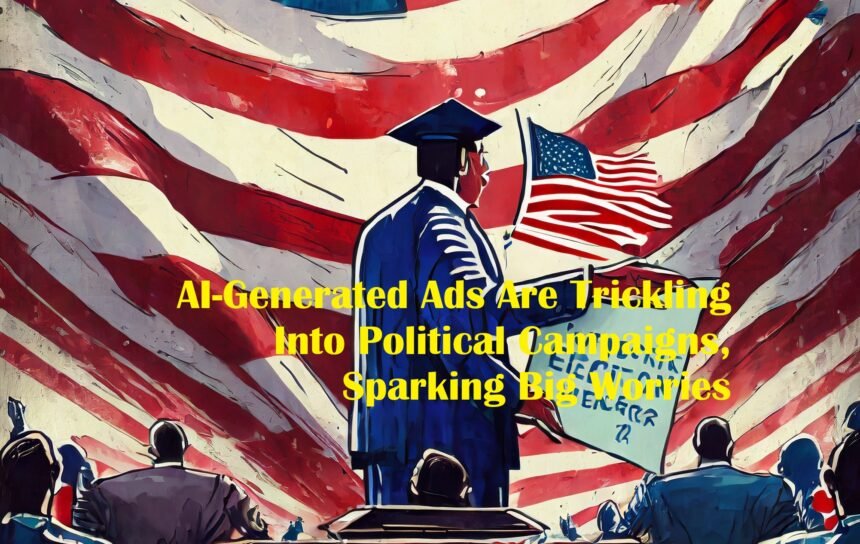
Artificial intelligence is rapidly transforming the way political campaigns are conducted. One of the most controversial changes involves AI-generated advertisements. These ads are now appearing across local, state, and national races. Their rise has sparked serious concerns among experts, lawmakers, and voters.
Recent reporting highlights how quickly this trend is growing. At least 15 political ads using AI-generated content have aired since late 2025. These ads include synthetic voices, manipulated visuals, and fully fabricated scenarios. Many observers fear this is only the beginning.
The Rise of AI in Campaign Advertising
AI tools enable campaigns to produce content faster and more cost-effectively than ever before. Campaign teams can now generate realistic audio and video in minutes. This shift reduces reliance on traditional production methods. Some campaigns have already used AI to mimic voices.
Others have created fictional scenes to attack opponents. These techniques blur the line between reality and fabrication. The accessibility of AI tools has accelerated adoption. Even smaller campaigns can now produce high-quality media. This creates a more competitive but also more chaotic information environment.
Why Experts Are Concerned
The biggest concern is misinformation. AI-generated ads can easily mislead voters. They can present false statements as if they were real. This is especially dangerous during elections. Deepfake technology plays a key role here. It allows realistic manipulation of audio and video.
In past cases, fabricated clips of politicians have gone viral. These examples show how convincing such content can be. Experts warn that voters may struggle to distinguish real from fake. When trust erodes, democratic systems become vulnerable. Even a small number of misleading ads can influence public opinion.
Regulatory Gaps and Legal Challenges
Another major issue involves regulation. Laws governing AI in political ads remain limited. While some regions have rules on deepfakes, many gaps still exist. In the United States, only certain states regulate deceptive AI content. At the federal level, proposed disclosure laws have stalled.
This leaves campaigns with significant freedom. The lack of consistent rules creates confusion. Campaigns may exploit these gaps to gain an advantage. Meanwhile, voters receive little protection from misleading content.
The Speed and Scale Problem
AI-generated ads can spread rapidly across platforms. Social media amplifies their reach. Once released, content can circulate widely within hours. This speed makes it difficult to respond. Fact-checkers and regulators often lag behind.
By the time corrections appear, the damage may already be done. AI also enables mass production. Campaigns can generate dozens of variations of the same message. This increases exposure and reinforces narratives, whether true or false.
Ethical Questions in Political Communication
The use of AI raises serious ethical concerns. Political campaigns have always used persuasive messaging. However, AI introduces a new level of manipulation. Some argue that AI tools simply enhance creativity. Others believe they cross a line.
When ads fabricate reality, they undermine informed decision-making. There is also concern about accountability. It can be hard to trace who created AI-generated content. This makes it easier to spread deceptive material without consequences.
Impact on Voter Trust
Trust is essential in any democracy. AI-generated ads threaten that trust. When voters cannot rely on what they see or hear, skepticism grows. Research suggests that people already worry about AI in elections. Many expect misleading content to increase.
This perception alone can damage confidence. If voters begin to doubt all political content, meaningful debate suffers. Genuine messages may be dismissed as fake. This creates a dangerous cycle of distrust.
Global Examples and Growing Trends
The use of AI in politics is not limited to one country. Campaigns around the world are experimenting with these tools. In Indonesia, AI-generated imagery played a role in recent elections. Similar trends appear in other regions.
Deepfake videos and synthetic voices are becoming more common. These developments show that the issue is global. As technology improves, the realism of AI-generated content will increase. This makes early action even more important.
Efforts to Address the Problem
Some steps are being taken to reduce risks. Technology companies have introduced labeling systems for AI-generated content. These labels aim to increase transparency. Governments are also exploring new regulations.
In Europe, laws now focus on transparency in political advertising. These rules may serve as a model for others. However, progress remains uneven. Many experts believe stronger measures are needed. Without coordinated action, gaps will persist.
The Future of AI in Campaigns
AI is unlikely to disappear from politics. Its advantages are too significant. Campaigns will continue to use it for outreach and messaging. The challenge lies in responsible use. Clear guidelines and ethical standards are essential.
Transparency must become a priority. Voters also need better media literacy. Understanding how AI works can help people identify misleading content. Education will play a key role in adapting to this new reality.