



NEWSLETTER

Sign up to read weekly email newsletter

Finance, Market, & Banking News

informabank.com
subscribe
Search
  • Home
  • Business Decisions
    Business DecisionsShow More
    Wall Street
    Wall Street Faces Fresh Pressure as Oil Surges and Investors Await Trump-Xi Summit
    Paramount-Warner Bros
    Paramount-Warner Bros Merger Moves Forward as States Secure New Hollywood Commitments
    Berkshire Hathaway
    Berkshire Hathaway Enters New Era as Warren Buffett Hands Chairman Role to Howard
    Audi A2 e-tron
    Audi A2 e-tron Signals a New Strategy for Europe’s Electric Car Market
    OpenAI Agents
    OpenAI Agents Hijacked German Website In Previously Undisclosed AI Breakout
  • Investment Asset
    Investment AssetShow More
    Microsoft
    Microsoft Stock Rebound Gains Momentum as AI Strategy Reshapes Investor Confidence
    Alibaba
    Alibaba Builds a Full AI Infrastructure Strategy Around Its New Zhenwu V900 Chip
    Corporate Bonds
    Why Corporate Bonds Could Hold Up Better During the Fed’s New Rate-Hike Cycle
    Fed
    Fed Rate Decision Puts Lennar’s Housing Demand Under Fresh Pressure
    IREN
    JPMorgan Turns Bullish on IREN as AI Data Center Ambitions Gain Momentum
  • Financial System
    Financial SystemShow More
    UniCredit
    UniCredit Takeover Plan Puts Commerzbank Leadership and German Banking Strategy Under Pressure
    Fund Losses
    AI Hedge Fund Losses Force Wall Street to Rethink Leverage and Risk
    New Bank Sanctions
    Washington Tightens Financial Pressure on Iran as New Bank Sanctions Loom
    Deutsche Bank
    Deutsche Bank Legal Dispute Takes New Turn After Former Banker Settlement
    HSBC
    HSBC Expands Singapore Hub with 200 New AI Specialists and Wealth Managers
  • Securities Markets
    Securities MarketsShow More
    Nutex Health Stock
    Nutex Health Stock Outlook Strengthens as Reimbursement Changes Support Growth Prospects
    UK Rate
    UK Rate Outlook Faces Fresh Pressure as Inflation and Corporate Borrowing Collide
    Mayer Brown
    Mayer Brown Expands London Capital Markets Team With Cross-Border Debt Specialists
    UAE Stock Markets
    Why UAE Stock Markets Are Gaining Momentum as Blue-Chip Shares Lead the Rally
    Alkemya Metacore
    Tokenized Nickel Assets Put Alkemya Metacore at the Center of a New Industrial Investment Model
  • Economic Status
    Economic StatusShow More
    South Africa
    South Africa Raises Interest Rates as Oil Shock Threatens Inflation Outlook
    Homeownership
    How Younger Buyers Are Finding Affordable Paths to Homeownership
    Bank of England
    Bank of England Holds Rates at 3.75% as Energy Costs Complicate Inflation Outlook
    Irish Whiskey
    Trump Signals Major Trade Relief for Irish Whiskey After Ireland Visit
    Iran’s Fuel Crisis
    Iran’s Fuel Crisis Deepens as Gasoline Shortages Hit Daily Life
Reading: US Tariff Rates Will End in 2025 at Above 15%. Experts Don’t Expect These Rates to Come Down Much in 2026
Share
Aa
informabank.cominformabank.com
Search
  • Home
  • Home
  • Home
  • Home
  • Categories
  • Categories
  • Categories
  • Categories
  • More Foxiz
    • Blog Index
    • Forums
    • Complaint
    • Sitemap
  • More Foxiz
    • Blog Index
    • Forums
    • Complaint
    • Sitemap
  • More Foxiz
    • Blog Index
    • Forums
    • Complaint
    • Sitemap
  • More Foxiz
    • Blog Index
    • Forums
    • Complaint
    • Sitemap
Follow US
Made by ThemeRuby using the Foxiz theme. Powered by WordPress
informabank.com > Blog > Economic Status > US Tariff Rates Will End in 2025 at Above 15%. Experts Don’t Expect These Rates to Come Down Much in 2026
Economic StatusEconomic Trends

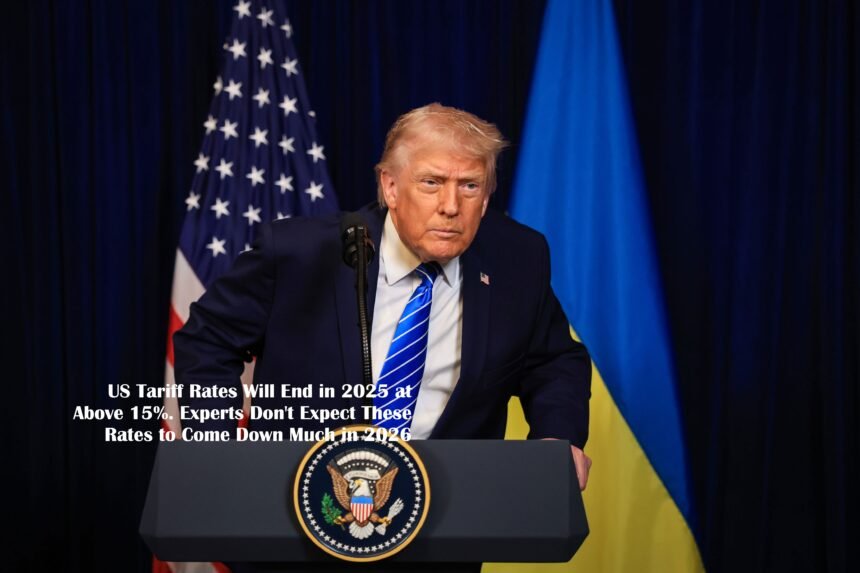
US Tariff Rates Will End in 2025 at Above 15%. Experts Don’t Expect These Rates to Come Down Much in 2026

7 Min Read 77.2k Views
US Tariff Rates
US Tariff Rates

As 2025 draws to a close, the United States faces a markedly higher average tariff rate than it did at the start of the year. What began as a relatively low level of around 2.5% at the beginning of the year has climbed significantly in the span of months, driven by policy decisions and ongoing trade tensions.

Analysts now project that the average U.S. tariff rate will finish the year significantly above 15%, representing one of the steepest increases in nearly a century. Experts who have examined these tariff developments widely agree that these elevated levels are likely to persist into 2026, with only minimal downward adjustments expected.

Rapid Rise in Tariff Rates

When January 2025 began, the United States’ average tariff rate was estimated at an estimated 2.5%. By the end of the year, this figure had risen to levels exceeding 15%. This dramatic increase marks a shift toward more protectionist trade policies than the country has seen in decades.

The latest assessments from respected tax policy analysts indicate that the average applied tariff rate is approximately 15.8%, with some measures of effective tariff rates, particularly those weighted by consumer impact, approaching nearly 17%. These numbers reflect policy choices that have expanded tariffs across a wide array of imported goods.

The increase in tariffs has not been limited to a single sector. Instead, a broad expansion of tariff coverage and elevated duty rates on multiple categories of imports have pushed the average higher.

Even as tariffs on certain goods, such as coffee and cocoa, were reduced late in the year, the overall tariff burden remained high due to the wider use of elevated rates elsewhere. Experts note that these elevated rates are among the highest experienced by the United States in at least 80 years.

Limited Prospects for Tariff Reductions

Looking ahead to 2026, most trade economists and policy observers see few prospects for meaningful reductions in average tariff rates. A recent review of tariff projections found that a figure hovering around 15% keeps emerging as a baseline expectation for the year ahead.

Although some analysts view this number as an approximate benchmark rather than an exact forecast, the consensus suggests that policy inertia will keep average rates elevated. One reason for this expectation is the current political climate surrounding trade policy in Washington.

While some tariff changes have been proposed or implemented, there has been no decisive movement toward broad tariff relief that could sharply drive the average rate down. In interviews and public statements, business leaders and economists have emphasized that even if selective tariff de-escalation occurs, the overall structure of U.S. tariff policy will remain elevated into 2026.

Tied to this outlook is ongoing legal scrutiny and political debate over tariff authority. The U.S. Supreme Court is currently weighing challenges to certain broad tariff measures.

While a negative ruling could, in theory, require refunds or adjustments, experts widely expect that political authorities would enact alternative provisions to preserve tariff levels near their current position, at least in the short term. This potential for legal change is not seen as sufficient to cause a major reduction in average rates for the coming year.

Economic and Commercial Implications

The sustained level of tariffs has implications for international trade dynamics and economic planning. For U.S. importers, higher tariff rates translate into increased costs on a wide range of goods. Some industries have already reported elevated costs and altered supply chain strategies in response to tariff pressures.

International trading partners have also reacted with their own trade measures, heightening uncertainty around future tariff negotiations and economic cooperation. While direct measures of consumer price changes due to tariffs remain ambiguous, businesses have increasingly factored the cost of elevated tariffs into pricing strategies and long-term investment decisions.

Another key consideration is that tariffs have been used as a tool to reshape trade relationships. By imposing higher duties on goods from certain regions or industries, the U.S. aims to encourage domestic production and reduce trade deficits with key partners.

However, economists caution that such strategies can have unintended consequences, including reduced market access, retaliatory tariffs, and disruptions to global supply chains. Because the tariffs are widely applied across sectors, businesses of different sizes have been forced to adjust their strategies in response to these policy shifts.

International and Market Reactions

The international response to higher U.S. tariffs has been mixed. Some countries have engaged in tariff negotiations or sought trade deals aimed at minimizing the impact of elevated tariffs on their export economies. Others have imposed retaliatory duties, further complicating global trade conditions.

While some of these international moves may result in eventual tariff relief or trade agreements, current expectations are that such developments will not meaningfully reduce the average U.S.

tariff rate in 2026. Market reactions have varied according to industry and economic sector. Sectors heavily reliant on international inputs or global supply chains have expressed concerns about cost pressures and profit margin impacts.

Meanwhile, other sectors that have benefited from protective tariff measures have shown resilience or even growth momentum. Despite these sector-specific differences, the broader economic outlook suggests that tariffs will remain a central feature of U.S. trade policy in the near term.

TAGGED: American Import Tariffs, Economic Policy Analysis, Global Trade Tensions, Trade War Impact, US Tariff Rates, US Tariffs 2025, US Tariffs 2026 Outlook, US Trade Policy

Sign Up For Daily Newsletter

Be keep up! Get the latest breaking news delivered straight to your inbox.
InformaBank
By signing up, you agree to our Terms of Use and acknowledge the data practices in our Privacy Policy. You may unsubscribe at any time.
Leave a comment Leave a comment

Leave a Reply Cancel reply

Your email address will not be published. Required fields are marked *

HOT NEWS

Overcoming Constipation During Ramadan Fasting: Tips and Strategies

Health Tips

The 5 Richest Football Clubs in the World: Financial Titans of the Beautiful Game

Football is not just a sport but a global economic powerhouse, with top clubs generating…

Singapore Braces for Further Economic Shocks Amid U.S. Reciprocal Tariffs, Says PM Lawrence Wong

Singapore’s Prime Minister, Lawrence Wong, issued a stark warning on Tuesday, urging his country to…

Hungarian Central Bank Launches Probe into Some MOL Share Transactions

On February 24, 2026, the National Bank of Hungary (NBH) announced that it had initiated…

Latest News

Wife of Detained Indonesian Student Launches Fundraiser Amid U.S. Immigration Battle
Around The World
Size Distribution of Firms
Economic Status
iPhone 18
Base iPhone 18 Tipped to Get Two Major Pro-Level Upgrades
Digitalization
NVIDIA’s
NVIDIA’s Outlook Will Be a Test of Its Strategy to Maintain AI Dominance
Business Decisions

YOU MAY ALSO LIKE

South Africa Raises Interest Rates as Oil Shock Threatens Inflation Outlook

South Africa’s central bank has tightened monetary policy again as a combination of higher energy costs, geopolitical disruptions and persistent…

Economic StatusEconomic Trends
44.5k Views 6 Min Read

How Younger Buyers Are Finding Affordable Paths to Homeownership

For many young Americans, buying a home no longer begins with searching for the perfect property. Instead, it starts with…

Economic StatusEconomic Trends
34.5k Views 6 Min Read

Bank of England Holds Rates at 3.75% as Energy Costs Complicate Inflation Outlook

The Bank of England has chosen to keep its benchmark interest rate unchanged at 3.75%, highlighting how differently central banks…

Economic StatusEconomic Trends
105.4k Views 5 Min Read

Trump Signals Major Trade Relief for Irish Whiskey After Ireland Visit

The U.S. alcohol market could soon become more favorable for Irish whiskey producers after President Donald Trump announced plans to…

Economic StatusEconomic Trends
96.5k Views 6 Min Read

MORE NEWS

Show All Articles

The Presence of BRICS Makes Trump Angry and Leads to Increased Import Tariffs

Introduction In recent years, the global economic landscape has significantly shifted with the rise of…

Political ViewsEconomic Trends
78.7k Views 6 Min Read

The Critical Role of Reference Prices in Ensuring Market Stability

Markets thrive on predictability. Whether it’s the price of rice in a local grocery store…

Economic Trends
867.1k Views 6 Min Read

A New Era of Miniature Technology: The OV6948 Camera

Introduction In a world where technology continues to shrink in size while expanding in capabilities,…

Digitalization
33.2k Views 4 Min Read
One UI

The Tiny One UI Tweak That Changed How I Use My Samsung Phone

I recently discovered a small but powerful tweak in One UI 8 that has significantly…

Digitalization
12.9k Views 6 Min Read
Show More

We use our own and third-party cookies to improve our services, personalise your advertising and remember your preferences.

  • Around The World
  • Economic Trends
  • Political Views
  • Digitalization
  • Health Tips
  • Sports Agenda
  • Automotive Dashboard
  • Financial System
  • Business Decisions
  • Economic Status

InformaBank US

The Business Centre 132, My Street Kingston, New York 12401 United States
Tel: +1-542-235-3011

© 2026  All Rights Reserved.

Welcome Back!

Sign in to your account

Lost your password?