


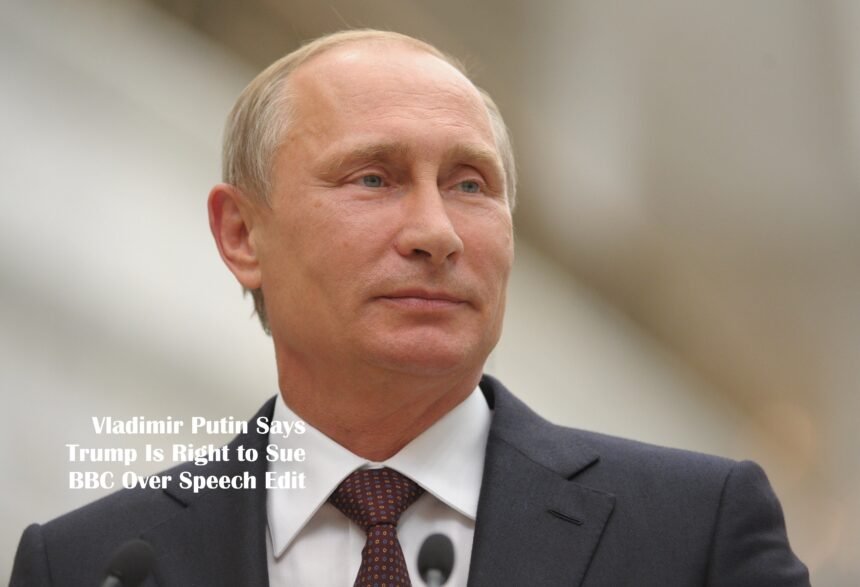
Russian President Vladimir Putin publicly supported U.S. President Donald Trump’s decision to sue the BBC over edited footage of a speech. At an annual end-of-year press event, Putin said Trump was justified in pursuing legal action over how his remarks were presented in a documentary.
The lawsuit seeks billions of dollars in damages and highlights rising tensions over media accuracy and political accountability. Putin’s comments shocked political observers around the world.
Trump’s decision to take the BBC to court centres on allegations that edited clips of a 2021 speech made it appear he encouraged violence. He filed the lawsuit in a U.S. federal court and claimed that the broadcaster misrepresented his words. The BBC has apologised for how the footage was presented. However, it plans to vigorously defend itself in the litigation.
Putin’s public endorsement of Trump’s legal strategy was unusual, given the history of strained U.S.–Russia relations. His remarks drew attention to the broader debate about media responsibility, political bias, and legal recourse. This development comes amid a broader wave of disputes between media organisations and high-profile political figures.
Origins of the BBC Controversy
The legal battle began after a documentary included clips from Trump’s speech on January 6, 2021. According to the complaint, the footage was edited in a way that changed its meaning. Trump said parts of his speech were spliced together to give a false impression that he incited supporters to storm the U.S. Capitol.
The edited version omitted context and combined segments in misleading ways. The BBC acknowledged the edit and issued an apology to Trump. The broadcaster admitted the presentation mistakenly gave the wrong impression, although it did not agree with the legal claims. Despite its apology, it rejected the idea that the edit constituted defamation under U.S. law.
BBC executives said there was no legal basis for the lawsuit. The apology focused on acknowledging the editing error and expressing regret for how it appeared.
Two senior leaders at the BBC resigned following the controversy, reflecting internal turmoil and public scrutiny. The resignations signalled the seriousness of the situation within the organisation. Even so, the BBC has vowed to defend itself and has stated that it will not back down from the legal challenge.
Trump’s Lawsuit: Scope and Claims
Trump’s lawsuit seeks at least $10 billion in damages, with claims filed in Miami federal court. The complaint includes counts of defamation and violations of consumer protection laws. His legal team argues that the edited footage wrongfully harmed his reputation and misled audiences.
The suit alleges that the BBC made false and malicious edits to his speech, which had broad implications during a politically sensitive period. In the legal filing, Trump’s lawyers asserted that the documentary presented a version of events that altered the original meaning of his remarks.
They argued that traditional journalistic standards were breached and that the incorrect representation damaged his public image. The lawsuit also alleges the BBC engaged in deceptive practices. Trump’s strategy of pursuing legal claims against media organisations is not new.
In recent years, he has filed multiple lawsuits against U.S. broadcasters and news outlets he believes defamed him or misrepresented his actions. Some cases resulted in settlements, while others remain open. The lawsuit against the BBC marks a rare instance of cross-border legal action involving a major international broadcaster.
Putin’s Support and Its Implications
Putin’s endorsement at his end-of-year press conference drew immediate global attention. By signalling support for Trump’s lawsuit, Putin highlighted his own view that media accountability matters in highly charged political environments.
Observers noted that his comments might resonate with audiences sceptical of mainstream media, particularly those who feel media outlets have an outsized influence on public discourse. Putin framed the lawsuit as an issue of fairness and accuracy. He said Trump was right to pursue what he saw as a remedy for what he described as a serious editorial error.
Analysts point out that Putin’s stance aligns with a broader narrative he has promoted about Western media bias. However, the remarks also risk complicating diplomatic relations between global political powers. Some critics said Putin’s backing of Trump could be interpreted as an attempt to amplify divisions in Western societies.
Supporters argued it underscored legitimate concerns about how editing decisions can shape public perceptions of political figures. The debate on media ethics, defamation law, and political influence took on new urgency after the public endorsement by the Russian president.
BBC’s Defence and Response
Despite facing a substantial lawsuit, the BBC has taken a firm stand. Its leadership clarified that the broadcaster would defend the case. Representatives said that even though the edit was a mistake, it did not rise to the level of defamation.
Lawyers for the BBC have emphasised that the documentary was not broadcast in the U.S. and that proving harm under American defamation law could be difficult. The BBC’s public statements stressed editorial independence and the need to withstand legal and political pressures.
Its defenders argued that media organisations must be able to make editorial decisions without fear of crippling lawsuits. Internal leadership changes and public apologies were part of the broadcaster’s effort to contain the fallout and reaffirm its commitment to journalistic standards.
The BBC’s defence may include arguments that context and intent are key factors in defamation cases. The organisation also noted that it would not offer financial compensation, focusing instead on legal defence. Supporters of the BBC’s stance emphasise the importance of protecting press freedom and caution against setting precedents where lawsuits could chill journalistic reporting.
Broader Political and Legal Context
The lawsuit reflects broader tension between political figures and media outlets. Debates over media accuracy and bias have become increasingly prominent in recent years. Many political leaders have criticised perceived unfair coverage, while journalists defend their work as essential to democratic discourse.
This dispute adds to the larger conversation about how societies balance free expression with accountability. Legal experts note that defamation lawsuits involving high-profile figures face complex challenges. Public figures must meet strict legal standards to prove that a media organisation acted with actual malice.
In this case, Trump’s legal team must show that the BBC knowingly broadcast false information or acted recklessly. Courts will scrutinise both the editing process and the broader context of media practices. Observers also highlight jurisdictional questions.
Because the documentary was not widely broadcast in the U.S., some legal analysts question whether U.S. courts are the proper venue. The BBC may argue the lawsuit should be dismissed on technical grounds. These legal dynamics could shape future media-related litigation involving international outlets.