



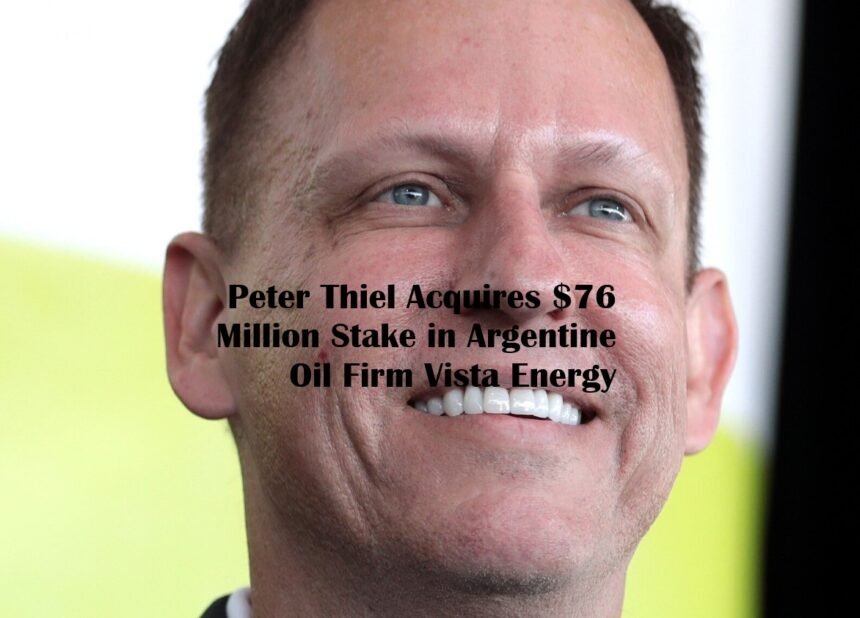
Billionaire venture capitalist and Palantir co-founder Peter Thiel has acquired a 1% stake in Vista Energy, a major independent oil producer operating in Argentina’s Vaca Muerta shale formation. According to an official regulatory filing with the United States Securities and Exchange Commission, Thiel made the investment through his hedge fund, Thiel Macro LLC. The fund purchased roughly 1.2 million American Depositary Shares of the energy firm, an asset allocation valued at approximately $76 million.
This strategic entry into Latin America’s energy landscape highlights growing global investor interest in Argentina’s burgeoning shale resources. It also marks a significant expansion of Thiel’s investment portfolio beyond traditional Silicon Valley software firms.
Deepening Strategic Ties with Argentina’s Economic Reforms
Thiel’s substantial equity purchase follows a high-profile personal meeting with Argentine President Javier Milei. The two leaders met four months ago at the presidential palace in Buenos Aires to discuss free-market economic policies, international investment incentives, and opposition to wealth taxes. Milei has consistently advocated for aggressive deregulation to unlock the full potential of the country’s vast natural resources.
The political shift toward economic liberalization under Milei’s administration has energized international capital markets. Foreign investors view these reforms as an opportunity to secure valuable assets in a deregulated environment. Thiel’s purchase signals strong private-sector confidence in the long-term stability of these economic reforms.
- Presidential Dialogue: Thiel discussed regulatory rollbacks and tax policies directly with Javier Milei.
- Local Property Purchase: Thiel recently bought a residence in Buenos Aires, signaling a long-term commitment to the region.
- Pro-Market Policies: Free-market reforms continue to attract foreign venture capitalists to Argentine assets.
- Capital Market Confidence: International drillers benefit from renewed access to international credit lines.
Unlocking the Immense Potential of Vaca Muerta Shale
Located in the Neuquén province of Patagonia, the Vaca Muerta formation is a massive geological resource roughly the size of Belgium. It holds the second-largest shale gas reserves and the fourth-largest shale oil reserves in the world. Vista Energy has established itself as one of the top independent operators in the basin, pumping about 160,000 barrels of oil equivalent daily. The energy producer has already poured over $6.5 billion into developing itsPatagonian acreage, recently raising its production targets.
Furthermore, Vista exports about 70% of its crude production, generating vital foreign currency reserves for the domestic economy. Ongoing infrastructure developments, including new export pipelines and deepwater ports, will boost the firm’s transport capacity significantly.
- Massive Scale: Vaca Muerta forms the backbone of Argentina’s plan to become a net energy exporter.
- Infrastructure Upgrades: New pipeline construction will streamline crude shipments to global buyers.
- High Production Capacity: Vista’s aggressive expansion plans continue to yield higher daily crude volumes.
- Export Dominance: Shipping the majority of its oil overseas protects Vista from domestic market volatility.
Aligning Energy Reserves with Artificial Intelligence Infrastructure
Beyond traditional oil and gas dynamics, Thiel’s broader portfolio suggests a clear strategic focus on long-term electricity and power generation. Thiel Macro LLC holds substantial equity positions in several major utility and power companies, alongside tech giant Amazon. This thematic focus points toward a calculated bet on the rising power demands of artificial intelligence and global data centers. Data centers require continuous, high-capacity baseload power to operate advanced machine learning models.
President Milei has repeatedly expressed his desire to leverage Patagonia’s vast open spaces and cool climate to build giant computing facilities. Securing reliable energy supplies in the region forms a critical prerequisite for building out this next-generation digital infrastructure.
- AI Power Demand: Expanding machine learning networks requires massive increases in global electricity generation.
- Synergistic Portfolio: Utility investments complement tech holdings by securing necessary energy pipelines.
- Data Center Ambitions: Cold Patagonian climates offer natural cooling advantages for large server farms.
- Diversified Exposure: Investments span nuclear power developers, traditional utilities, and shale drillers.
Setting a Precedent for Foreign Tech Capital in Natural Resources
Thiel’s investment in Vista Energy highlights a broader trend of technology figures financing traditional industrial and energy assets. As energy security becomes tightly linked with technological competitiveness, prominent tech leaders are increasingly funding primary resource extraction. Other major American energy firms, including Chevron, have also expanded their footprint across the Patagonian shale patch recently. The arrival of high-profile venture capital confirms that international markets view Argentina’s energy sector as a premier investment frontier.
- Cross-Sector Flows: Silicon Valley capital increasingly moves into traditional energy infrastructure.
- Validated Reform: High-profile investments encourage other international institutions to enter the market.
- Global Competitiveness: Abundant domestic power positions Argentina as an attractive destination for foreign capital.
- Sustained Growth: Capital infusions accelerate infrastructure completion across Neuquén province.
The Future Trajectory for Argentine Energy Markets
Peter Thiel’s purchase of a 1% stake in Vista Energy marks a pivotal moment for foreign investment in South America’s energy corridor. By backing one of Vaca Muerta’s most efficient drillers, Thiel gains direct exposure to expanding crude exports and regional power generation.
As Javier Milei’s free-market policies take deeper root, Argentina appears poised to solidify its role as a major energy supplier to the global economy. The integration of traditional shale resources with modern computing needs will likely drive further capital allocations into the region for years to come.