



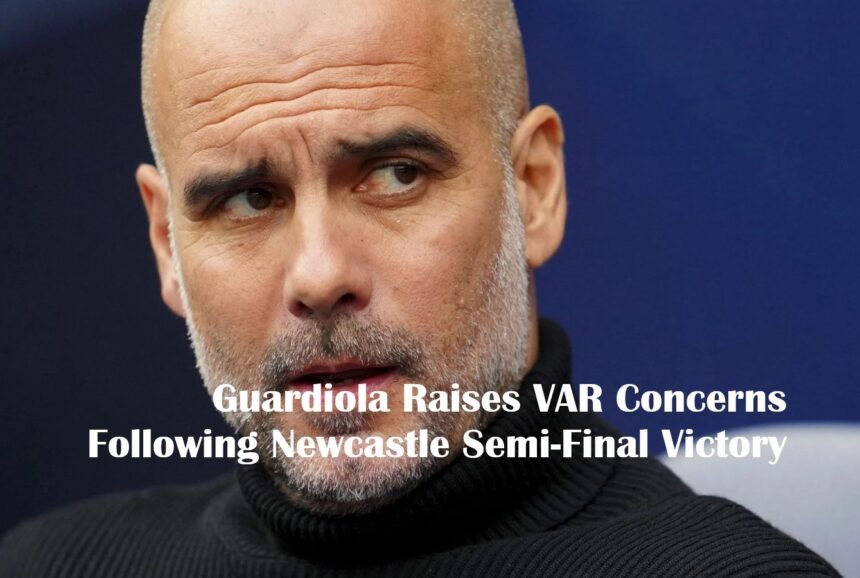
Manchester City manager Pep Guardiola voiced serious concerns about the Video Assistant Referee (VAR) process after his team secured a 2-0 win over Newcastle United in the first leg of their Carabao Cup semi-final.
Although City’s performance was strong enough to earn them an advantage, the result was overshadowed by a controversial VAR decision that disallowed one of City’s goals after a lengthy review. The episode has reignited debate about the consistency and transparency of the technology designed to assist referees in making correct decisions on the pitch.
Victory and Controversy at St James’ Park
City traveled to St James’ Park with confidence, and early in the second half, they took the lead through a well-worked goal by Antoine Semenyo. The forward, recently signed and making just his second appearance, tapped in a cross to open the scoring in what was a well-deserved lead for Guardiola’s side.
Moments later, Semenyo appeared to have doubled the advantage when he converted a corner with a composed finish. However, following a prolonged VAR check that lasted more than five minutes, the goal was ruled out for offside.
VAR determined that Erling Haaland had been in an offside position and impeded a defender in the build-up, despite City’s belief that his position did not materially affect the play. The match continued with tension rising among players and staff, and late in stoppage time, Rayan Cherki scored to secure the 2-0 result.
While City left Newcastle with a valuable lead ahead of the second leg, the narrative of the night was dominated by questions over the VAR decision rather than the team’s overall display.
Guardiola’s Post-Match Frustrations
Guardiola was candid in his post-match comments, expressing frustration with the way VAR was applied during the match. He questioned why what he described as marginal moments were subject to lengthy scrutiny, particularly in contrast with other incidents earlier in the season that he felt were overlooked.
When asked about the disallowed goal, the City manager stated that explanations had not yet been provided, but he expected to hear from the head of officiating regarding the decision. He reiterated that his issue was not with the officials themselves but with the inconsistency in when VAR intervened and when it did not.
Guardiola referenced a previous league match at the same venue, when a penalty appeal for his side was not reviewed by VAR. He also mentioned an earlier moment in the season when what appeared to be a clear foul on a teammate was not acted upon. These unaddressed episodes, he said, contrasted sharply with the rigorous assessment that led to Semenyo’s goal being ruled out.
Broader Questions Around VAR Consistency
The debate sparked by Guardiola’s comments touches on a wider concern in modern football: whether VAR is applied consistently and fairly across all match situations. The technology was introduced with the aim of reducing human error and increasing fairness in officiating, but its real-world application has frequently sparked controversy.
Supporters of VAR laud its ability to intervene in clear mistakes that would otherwise go unpunished, such as missed goals or penalty situations. However, critics argue that subjective interpretations, especially around offside and contact between players, can undermine the flow of the game and leave teams feeling unjustly treated.
In this instance, Guardiola’s broader point was that technology seemed to be capable of identifying and overturning one decision while failing to address other moments that appeared equally important. His media comments reflected a belief that VAR’s role should be more consistent, with clearer communication about when and why it is used.
Impact on Team and Fans
For Manchester City, the result itself was positive, with a two-goal cushion secured away from home ahead of the return leg. Guardiola’s squad demonstrated resilience in adapting quickly after the disallowed goal, and Cherki’s late strike will provide confidence going into the next match.
Nevertheless, the decision to disallow Semenyo’s goal was felt by many observers to have disrupted the rhythm of the game. Players were left waiting on the pitch as the review continued, and fans in the stadium were subjected to a prolonged delay, which affected the match’s momentum.
The incident also stirred reactions from former players and pundits, some of whom believe that VAR’s current implementation can lead to situations where the spirit of the game is challenged by technical interpretations.
Although the call in this game was ultimately upheld as correct under current rules, the time taken to reach the conclusion drew particular ire from those who feel match-flow is too often interrupted by such decisions.
Looking Ahead
Ahead of the second leg at the Etihad Stadium, Guardiola’s focus will remain on preparing his team both tactically and mentally. With a strong aggregate lead, City are well positioned to reach the Carabao Cup final, although Newcastle will be determined to overturn the deficit in front of their own fans.
Yet beyond the immediate sporting implications, Guardiola’s comments have once again sparked discussion about how football’s governing bodies manage and refine the use of VAR.
Whether this leads to adjustments in protocols or greater clarity in communication with teams and supporters remains to be seen. What is clear is that debates over technology in football are likely to continue as long as high-stakes decisions are influenced by interpretations made off the field.