



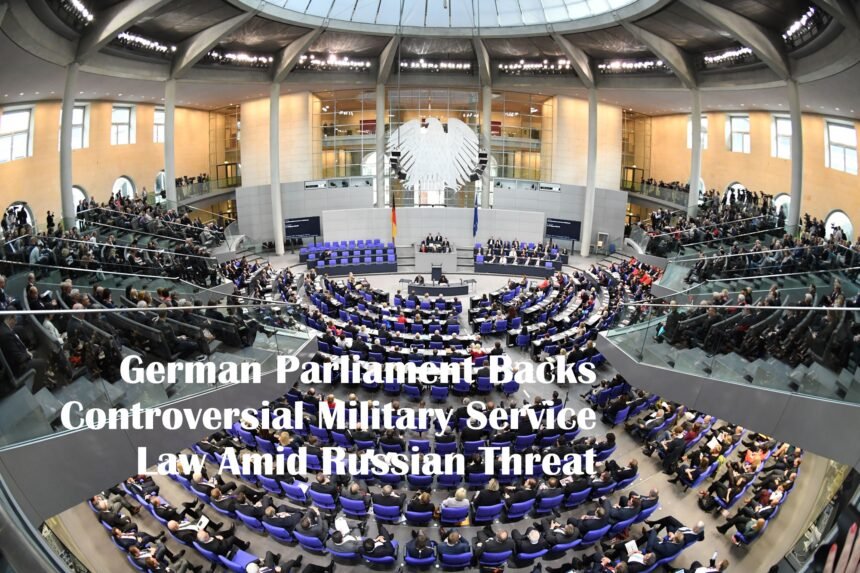
The German lower house has approved a new military-service law that aims to significantly expand the size of the country’s armed forces. The move reflects growing concern over Russia’s military posture and rising pressure across Europe for stronger defensive readiness.
According to the law, a dual-track recruitment system will be implemented, combining voluntary enlistment with the possibility of conscription should voluntary numbers prove insufficient. Lawmakers backed the new legislation after months of intense debate.
Under the new rules, all young adults turning 18 will receive a questionnaire asking whether they are willing to serve. For men born on or after January 1, 2008, a medical evaluation will also be required to assess their fitness for service.
What the Law Proposes: Targets, Timeframe, and Mechanism
The plan aims to raise active troop numbers to as many as 260,000, up from roughly 183,000 currently, and to build a reserve force of at least 200,000 by 2035. Under the dual-track system, voluntary service will become the main route for enlistment.
To make this option more attractive, the government plans incentives such as improved pay and benefits. Should volunteer recruitment fall short, parliament can authorize needs-based conscription, potentially via a random-selection mechanism among eligible individuals.
The defence ministry must report recruitment numbers to parliament every six months. This requirement aims to ensure transparency and allow lawmakers to monitor whether voluntary enlistment suffices or conscription must be activated.
Why Germany Is Taking This Step
The decision reflects a significant shift in Germany’s defence posture. The country’s armed forces have struggled to meet troop targets after the previous suspension of conscription in 2011. But rising geopolitical tension, especially the threat from Russia and its military aggression in recent years, has pushed Berlin to reshape its defence strategy.
Officials argue that a larger, well-staffed military is essential to meet obligations under NATO and to deter potential threats. According to military leadership, the army needs “at least 100,000 more active troops” beyond current levels to meet new readiness targets.
The Debate and Controversy Around Conscription
While the new law emphasizes voluntary service first, some critics worry about the return of conscription. Many view compulsory military service, even in a limited form, as a step backward. Others argue that relying solely on volunteers may not yield enough numbers, especially given the reluctance among many young people to join the military.
Some lawmakers and civil-society voices warn that any reintroduction of compulsory service could spark political and social tensions, especially among youth who view mandatory enlistment as a threat to personal freedom. Yet proponents argue that selective conscription serves as a necessary fallback to guarantee national security, especially under worsening threat conditions.
What This Means for the Future of Germany’s Military
If the plan succeeds, Germany’s armed forces could grow markedly in size and capability over the next decade. The 260,000-active-duty target plus 200,000 reservists would give the armed forces more manpower than in recent years. Such growth could improve readiness, boost deterrence capacity, and help meet alliance commitments.
At the same time, the dual-track system introduces flexibility. It seeks to avoid a full-blown universal draft by relying on volunteers first. If voluntary interest proves insufficient, the conditional conscription mechanism provides the state with a safety net to ensure force strength.
Biannual reporting to parliament should provide public visibility into recruitment progress and help keep the process accountable.
Risks, Challenges, and Social Implications
Even with the law approved, implementing it will not be easy. Recruiting new volunteers may prove difficult many young people may be unmotivated or unwilling to join the military. The optional-then-conditional structure might still face public resistance if conscription is activated.
Germany must also build the infrastructure to process large numbers of medical evaluations, interviews, training slots, and administrative support. That will require investment and resources at a time when defence budgets and public opinion remain under scrutiny.
Moreover, relying on a selective system might leave gaps: certain regions or social groups may be over- or under-represented. Ensuring fairness and transparency will be a challenge, especially if random selection is used for conscripts.
The long-term social impact may also be significant. Reintroducing conscription even in a limited form could reignite debates about civil liberties, equality (given only males are required to respond), and military culture in a modern democracy.
Broader Implications: Europe’s Evolving Defence Posture
Germany’s move echoes a wider trend across Europe. Several countries have already strengthened their defence posture, either by expanding voluntary service or reintroducing conscription in some form. The rising threat from Russia has accelerated this shift. As Europe recalibrates security strategies, Germany’s vote may influence others.
A larger German military could serve as a deterrent and encourage more cooperation among NATO allies. At the same time, the law may reshape public attitudes in Germany toward military service and national defence. Younger generations may reconsider their views on service and citizenship in light of changing national security dynamics.