



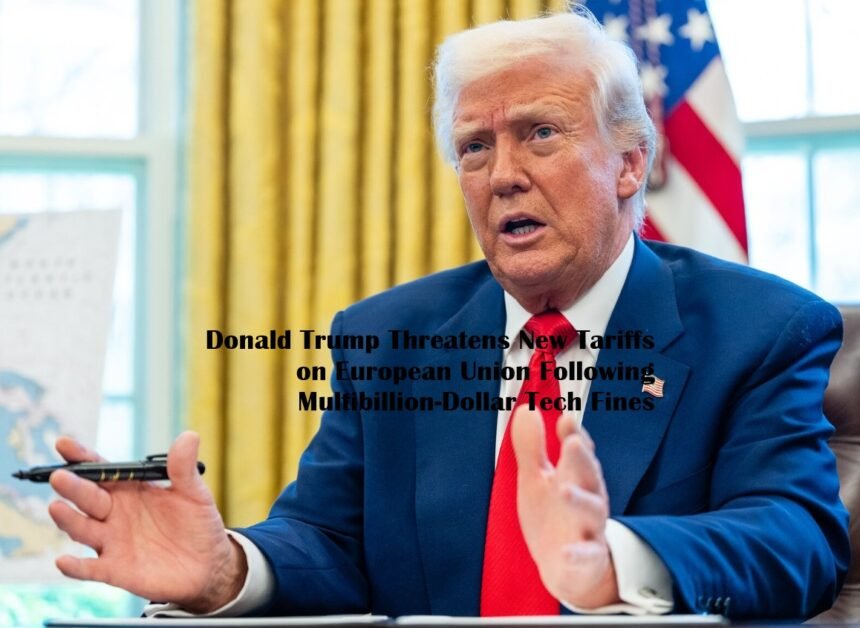
President Donald Trump sharply escalated transatlantic trade tensions by threatening to impose substantial new tariffs on the European Union. The dramatic warning came in direct response to European regulatory authorities levying heavy financial penalties against major American technology corporations.
Trump declared that his administration will not allow foreign governments to treat the United States as an economic piggy bank. He vowed to initiate an immediate trade investigation that could trigger sweeping retaliatory duties across European imports. The sudden friction highlights deepening divisions over global technology regulation, digital taxation, and international trade policy. European regulators have systematically tightened oversight on foreign digital platforms to enforce fair competition standards.
However, Washington views these recurring regulatory fines as discriminatory acts designed to siphon cash from leading American innovators. This growing dispute threatens to undo fragile trade agreements and reignite a full-scale economic confrontation across the Atlantic.
Escalating Tensions Over Multibillion-Dollar Tech Penalties
The immediate catalyst for Trump’s tariff threat is a fresh €890 million ($1 billion) penalty imposed on a major search platform. European antitrust officials penalized the firm for favoring its internal commercial services over rival offerings. Additionally, European regulators cited app store policies that restricted software developers from steering users toward cheaper external payment options. This ruling represents one of the largest enforcement actions under regional digital competition statutes.
This recent enforcement action follows a broader pattern of regulatory scrutiny targeting high-profile American companies. Over recent years, European authorities imposed multi-hundred-million-dollar fines against leading social media platforms, consumer device makers, and e-commerce portals.
American political leaders argue that these penalties unfairly target American market leaders while exempting regional competitors. Consequently, the White House interprets these regulatory penalties as disguised trade barriers designed to extract revenue from American corporate balance sheets.
Deploying Section 301 Investigations as Trade Leverage
To address these perceived injustices, President Trump announced plans to launch a formal Section 301 investigation. Under the Trade Act of 1974, Section 301 grants the executive branch broad authority to investigate foreign government practices. If federal investigators deem those practices unreasonable, discriminatory, or restrictive to American commerce, the president can unilaterally impose retaliatory tariffs. The administration previously utilized Section 301 provisions to justify tariffs against various global trading partners.
Legal experts note that using trade law to retaliate against regulatory fines represents a highly aggressive strategic pivot. By framing regulatory compliance fines as illegal trade barriers, Washington seeks to force European policymakers to reconsider their strict enforcement frameworks.
- Primary Tool: Section 301 of the Trade Act of 1974 allows unilateral trade investigations.
- Target: Unfair foreign regulatory actions, fine structures, and discriminatory market policies.
- Enforcement: Substantial import tariffs on key European manufacturing and agricultural goods.
Divergent Approaches to Digital Governance and Competition
The feud reflects a fundamental ideological split between Washington and European capitals regarding digital market regulation. European lawmakers favor proactive regulations that establish strict behavioral rules for digital gatekeepers. They argue that dominant online platforms destroy healthy competition, lock out smaller startups, and restrict consumer choices.
Therefore, European officials view heavy financial fines as necessary enforcement tools to maintain open, fair, and contestable digital markets. In contrast, American policymakers across the political spectrum often view these regulatory frameworks as anti-innovation traps.
They contend that aggressive antitrust penalties punish companies simply for being successful. Furthermore, American officials worry that European regulatory overreach limits the ability of domestic technology firms to scale global operations. This philosophical divide creates an ongoing stalemate where legal compliance in one jurisdiction triggers political retaliation in another.
Economic Fallout and Potential Supply Chain Disruptions
If the White House executes its tariff threats, the economic consequences will ripple across numerous global industries. New duties on European goods would instantly raise costs for American importers, distributors, and end consumers. Key sectors such as automotive manufacturing, luxury goods, wine production, and industrial machinery could face immediate price hikes. Higher import taxes frequently lead to reciprocal retaliatory tariffs, threatening to ignite an escalating trade war.
Corporate leaders on both sides of the Atlantic view the prospect of renewed tariff wars with deep concern. Global supply chains already face significant friction from ongoing inflationary pressures and shifting geopolitical alliances. Imposing additional trade barriers over technology fines adds unpredictability to international commerce. Businesses must navigate a volatile legal landscape where regulatory decisions directly threaten international sales pipelines.
Navigating the Future of Transatlantic Trade Relations
The coming months will test whether Washington and European officials can negotiate a constructive compromise. While technology executives welcome White House support against foreign fines, many prefer diplomatic stability over chaotic trade disputes. Prolonged uncertainty hurts long-term research investments, international expansion, and corporate planning. Ultimately, the clash over European tech fines highlights how digital governance has become a core battleground in modern geopolitical trade.
As technology platforms continue to dominate global economic activity, nations will fiercely defend their domestic companies and regulatory sovereignty. Whether through diplomatic negotiations or aggressive Section 301 tariffs, the resolution of this conflict will shape the future of international trade, digital commerce, and transatlantic relations for years to come.