


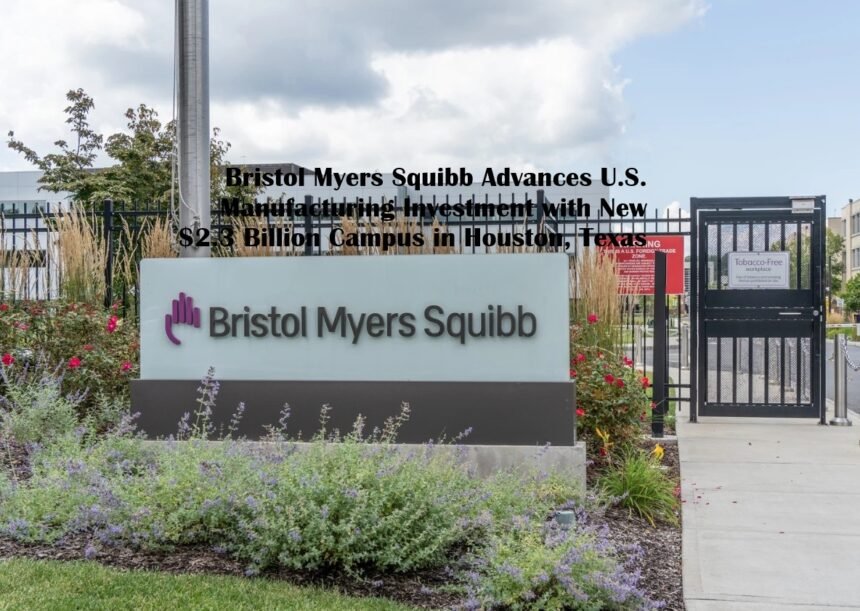
Global biopharmaceutical leader Bristol Myers Squibb has selected Houston, Texas, as the site for a new, state-of-the-art manufacturing campus. Representing an investment of approximately $2.3 billion, the project accelerates the delivery of next-generation medicines to patients worldwide.
The company chose Generation Park in northeast Houston as the home for the 600,000-square-foot facility. The development marks a crucial milestone in the company’s broader $40 billion five-year commitment to domestic research, technology, and manufacturing across the United States. The new campus will create nearly 500 permanent skilled jobs upon completion. Additionally, construction and indirect activities will generate roughly 2,000 extra jobs throughout the local community between 2027 and 2030.
A Milestone in American Biopharmaceutical Infrastructure
The strategic decision to build in Texas reinforces American leadership in life science innovation. Executives at Bristol Myers Squibb emphasize that domestic manufacturing capability protects global supply continuity. Building advanced production hubs within the United States buffers patient care against international supply chain shocks.
The investment supports the commercialization of complex therapies emerging from the company’s research pipeline. In 2025 alone, the organization directed approximately $10 billion into research and development. The new Houston hub bridges the gap between laboratory discovery and commercial patient delivery.
- Expanded Domestic Capacity: The facility increases domestic drug manufacturing output significantly.
- Pipeline Commercialization: Production teams will scale experimental treatments into approved therapies.
- Supply Chain Resilience: Local production minimizes reliance on overseas logistics corridors.
- Advanced Digital Technology: Smart automation optimizes operational efficiency and product quality.
Flexible Modular Architecture and Multi-Modal Production
Unlike conventional single-purpose pharmaceutical factories, the Houston facility features a modular and multi-modal architecture. Engineers designed the layout to adapt rapidly as drug portfolios evolve. From its first day of operation, the campus will handle small molecules, biologics, and antibody-drug conjugates under one roof.
The site supports the full lifecycle of drug product manufacturing from late-stage clinical development through commercial distribution. If market demand shifts, technicians can reconfigure modular cleanrooms without interrupting active production lines. Advanced digital systems collect real-time data across every stage of synthesis, ensuring strict quality control.
- Modular Adaptability: Cleanrooms adjust quickly to accommodate new production protocols.
- Multi-Modal Capability: The facility processes diverse drug platforms simultaneously.
- End-to-End Processing: Operations span formulate-to-fill stages and final package distribution.
- Integrated Automation: Robotics and digital software monitor cleanroom purity continuous.
Economic Impact and Job Creation in Greater Houston
The project delivers substantial economic momentum to the Greater Houston region. The company expects to hire nearly 500 full-time specialists for permanent operational roles. Available positions will include operations technicians, bioprocess engineers, quality control analysts, and maintenance specialists.
State and local leaders provided competitive incentives to secure the facility for Texas. The Texas Enterprise Fund extended a $4.89 million performance grant to support site development. Furthermore, the campus qualified under the state’s Jobs, Energy, Technology, and Innovation program, reflecting its strategic economic importance.
- High-Wage Employment: Permanent roles offer competitive salaries across science and engineering fields.
- Construction Surge: Tradesmen and contractors will gain multi-year employment during construction.
- Supplier Engagement: Local vendors will supply raw materials, maintenance, and logistics support.
- Talent Recruitment: The site taps into world-class graduates from nearby research universities.
Strengthening National Supply Chains and Healthcare Innovation
Maintaining robust domestic production capabilities remains a major priority for the biopharmaceutical sector. Modern drug manufacturing requires specialized environmental controls and flawless precision. By embedding modern automation within the Texas facility, the company strengthens its overall supply network resilience.
Company leaders stress that speed matters when treating serious illnesses. Flexible manufacturing lines reduce the lead time needed to move new clinical breakthroughs into hospital pharmacies. Patient outcomes improve when pharmaceutical supply chains deliver therapies without logistical bottlenecks.
- Rapid Deployment: Accelerates delivery of breakthrough treatments to treating physicians.
- Quality Assurance: On-site digital monitoring catches processing errors instantly.
- National Security: Protects essential medicine inventories during global trade disruptions.
- Operational Redundancy: Multiple domestic sites ensure continuous production uptime.
The Strategic Choice of Houston and Generation Park
Bristol Myers Squibb selected Generation Park in Houston after evaluating dozens of competing sites across the Central and Eastern United States. The 4,300-acre master-planned district offers superior utility access, robust freight transit, and space for long-term expansion. Houston’s fast-growing life science ecosystem provides an ideal operational foundation.
The region offers direct access to top-tier technical colleges and world-renowned research centers. Proximity to international airports and shipping corridors simplifies bulk logistics for global export. As construction gets underway in 2027, this $2.3 billion investment positions Houston as an indispensable hub for advanced biopharmaceutical manufacturing.