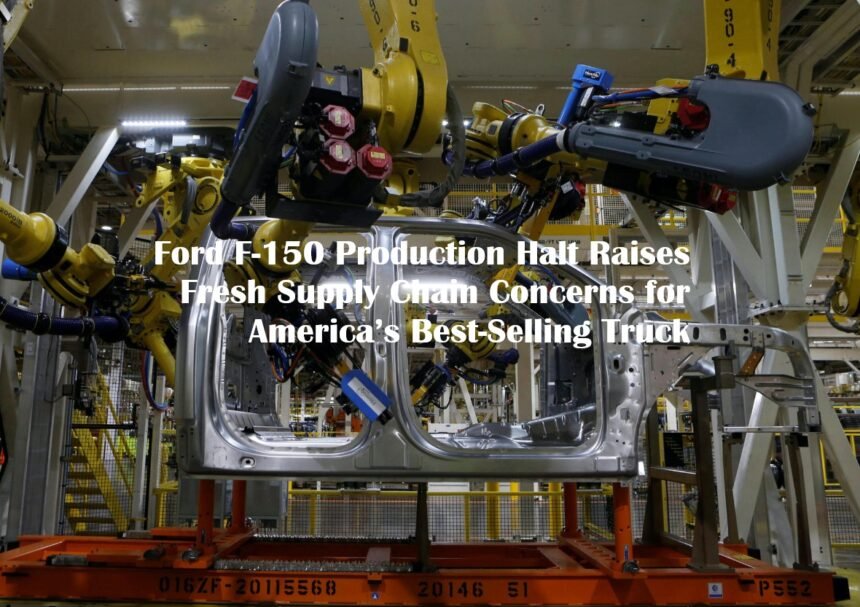
Ford is facing another disruption to its pickup truck manufacturing operations after production of the F-150 was suspended for several days at the company’s Dearborn Truck Plant in Michigan. The interruption highlights the continuing pressure on Ford’s supply chain at a time when the automaker is already working to recover lost vehicle output.
According to a memo reviewed by Reuters, all production crews at the Dearborn facility were canceled beginning Thursday, September 24, with the suspension scheduled to continue through Tuesday, September 29. A person familiar with the situation told Reuters that the latest shutdown was linked to a supply problem, although the specific supplier involved has not been identified.
Supply Disruption Spreads Beyond Dearborn
The impact has not been limited to Ford’s Michigan operation. Production schedules at other facilities involved in building F-Series trucks have also been adjusted as the company responds to the parts shortage. Ford’s Kansas City Assembly Plant canceled several shifts during the week because of the same issue affecting the Dearborn operation, according to a person familiar with the matter. At the same time, the automaker increased truck production at its Kentucky Truck Plant near Louisville in an effort to compensate for some of the lost output elsewhere.
The production changes illustrate how a problem affecting one part of an automotive supply chain can quickly force manufacturers to reorganize operations across multiple facilities. For Ford, the stakes are particularly significant because the F-Series represents one of the company’s most important vehicle lines. The F-150 has remained a cornerstone of Ford’s pickup business and has held the position of America’s best-selling vehicle for decades. As a result, even a short manufacturing interruption can have a meaningful effect on the number of trucks reaching dealers.
New Issue Is Separate From Earlier Aluminum Shortage
The latest supply problem comes as Ford continues dealing with the consequences of an earlier production setback involving an aluminum supplier. A fire at an aluminum supplier caused the automaker to lose tens of thousands of vehicles in production beginning late last year.
Ford has been attempting to recover the lost volume, making the newest disruption particularly significant for its manufacturing plans. However, the person familiar with the latest situation said the supply problem responsible for the current production changes is unrelated to the earlier aluminum shortage.
Reuters also reported that it was unable to determine which supplier was responsible for the latest issue. That distinction is important because it suggests Ford is dealing with a separate supply-chain challenge rather than an extension of the previous aluminum-related disruption.
Ford Already Faces Pressure on Vehicle Sales
The production interruption comes during a difficult period for Ford’s U.S. sales performance. Reuters reported that Ford’s overall vehicle sales were down about 10% year over year through August, while sales of its F-Series trucks had declined 11% over the same period. The figures add another layer of complexity to the production issue. Ford needs to maintain a steady supply of its most important trucks while also responding to changing demand across the U.S. automotive market.
Cox Automotive has projected that Ford and General Motors could experience some of the largest U.S. market-share losses among automakers during the first three quarters of 2026. The research firm also expects combined Hyundai and Kia sales to surpass Ford’s sales in the third quarter for the first time. These market developments make production stability increasingly important for Ford. A prolonged shortage of vehicles can affect dealer inventories and potentially limit the company’s ability to respond to customers who want specific truck configurations.
Why the F-150 Shutdown Matters
The financial consequences of stopping an automotive assembly line can accumulate quickly. Manufacturing facilities depend on carefully coordinated deliveries of components, labor schedules and production targets. When one essential part becomes unavailable, an entire production operation may have to pause.
For the F-150, the consequences are especially important because of the model’s scale within Ford’s business. The truck has been America’s best-selling vehicle for 44 consecutive years, according to Reuters. Ford’s decision to increase truck production at its Kentucky facility shows one way the company is attempting to reduce the effect of the disruption.
Nevertheless, shifting production between factories cannot necessarily replace every vehicle lost when another plant is forced to stop. The company’s ability to restore normal production at Dearborn and stabilize supplies will therefore be closely watched.
What Comes Next for Ford
For now, Ford’s Dearborn Truck Plant is scheduled to resume normal production after the cancellation period ends on September 29. The company’s response will depend partly on how quickly the underlying supply issue can be resolved. The latest disruption also demonstrates the challenges automakers face when their manufacturing networks depend on highly synchronized global and domestic suppliers. Even without another major facility-wide crisis, a shortage affecting a critical component can force production changes across several plants.
For Ford, restoring F-150 output is particularly important as it attempts to recover from previous production losses while navigating weaker sales figures and increased competition in the U.S. pickup market. The latest shutdown does not appear to be connected to the earlier aluminum supplier problem, but it nevertheless places additional pressure on Ford’s efforts to maintain consistent F-Series production.