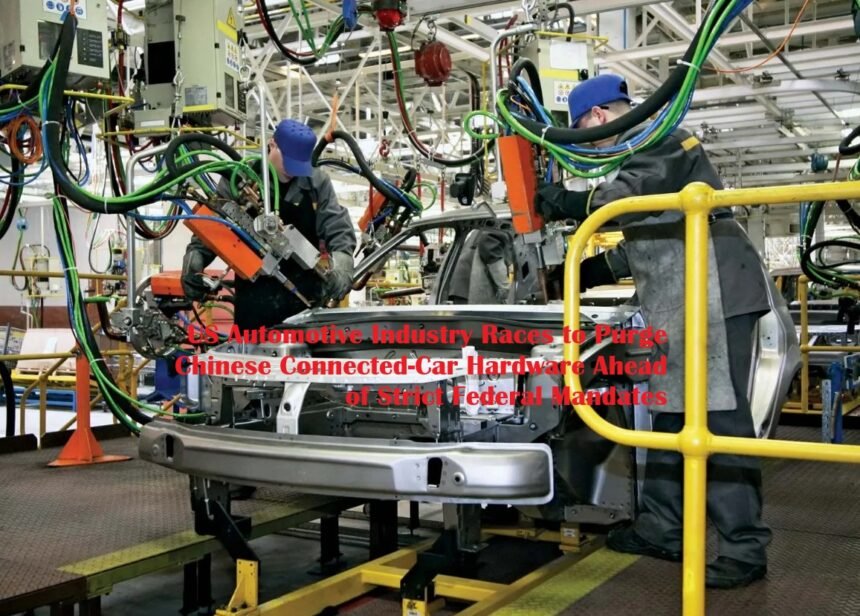
The American automotive sector is undergoing a massive operational overhaul as car manufacturers work frantically to strip Chinese connected-car hardware and software from their global supply chains. Driven by aggressive national security mandates from Washington, major automotive companies are auditing thousands of component suppliers to comply with upcoming federal regulations.
Federal officials argue that foreign-connected-car components pose critical cybersecurity threats, as modern vehicles collect vast amounts of real-time location data, personal information, and biometric data from driver devices. Consequently, carmakers face tight deadlines to replace foreign telematics units, cellular modems, and automated driving hardware with secure domestic or allied alternatives.
This technical purge represents one of the most complex supply chain realignments in modern industrial history. Over the past decade, automotive original equipment manufacturers increasingly relied on cost-effective Asian component makers to power their digital cockpits and vehicle connectivity systems.
Unwinding these deeply embedded technology partnerships requires automakers to re-engineer core vehicle architectures, rewrite Millions of lines of software code, and re-certify safety systems. Companies that fail to meet the upcoming compliance deadlines risk severe commercial penalties, including complete bans on selling affected vehicle models within the lucrative United States market.
Understanding the Cybersecurity and Data Vulnerability Risks
To appreciate the urgency behind this federal policy, industry analysts must examine how modern connected vehicles operate as mobile data centers. Contemporary cars feature dozens of microprocessors, onboard cameras, LiDAR sensors, and continuous cellular connections that communicate directly with cloud servers.
Government officials express deep concern that foreign state actors could exploit backdoors within Chinese-manufactured hardware to track high-ranking individuals, spy on military bases, or disrupt transport networks during potential geopolitical conflicts. Furthermore, remote software updates present a unique national security vulnerability that regulators are eager to eliminate. Modern vehicle operating systems rely on over-the-air updates to fix bugs, adjust engine performance, and upgrade infotainment systems.
If a hostile foreign entity gains control over these digital channels, hackers could remotely disable vehicle safety systems or cause widespread traffic paralysis across major American metropolitan areas. By banning Chinese connectivity modules and software code, the federal government aims to build an impenetrable digital firewall around the nation’s critical transportation infrastructure.
The Astronomical Financial Costs and Engineering Challenges of Redesign
While government officials emphasize national security, automotive executives are struggling with the immense financial and technical burdens of this policy transition. Replacing a single electronic control unit requires months of rigorous engineering design, thermal testing, and crash simulations.
Automakers must source entirely new silicon components from domestic chipmakers or trusted international partners in North America, Europe, and Japan. This sudden spike in demand for non-Chinese microchips is pushing component prices upward, directly inflating overall vehicle manufacturing costs.
Additionally, automotive engineers face severe labor bottlenecks as they race to rewrite complex software programs that control infotainment systems and driver-assistance features. Many vehicle models currently rolling off production lines use foreign middleware to connect hardware components to the central vehicle computer.
Replacing this underlying software framework requires thousands of engineering hours, forcing car companies to divert research budgets away from new electric vehicle platforms. Small-volume manufacturers and luxury brands face particularly steep profit margin compression because they cannot easily spread these fixed engineering costs across millions of vehicle units.
Rebuilding Resilient Regional Supply Chains and Domestic Manufacturing Capacity
The aggressive federal crackdown is accelerating a broader industrial trend toward nearshoring and regional manufacturing hubs. To ensure long-term compliance, major automakers are incentivizing top-tier auto suppliers to establish new production facilities within North America.
These localized manufacturing plants specialize in producing secure cellular modems, microcontrollers, and radar sensors that adhere to strict government cybersecurity standards. This regionalization strategy reduces exposure to international trade disputes and minimizes long-distance maritime shipping delays.
However, building local component ecosystems takes significant time and substantial capital investment. Building advanced semiconductor packaging plants and automated circuit board assembly lines requires years of construction and equipment installation.
In the interim, car manufacturers are negotiating temporary compliance waivers with federal authorities to prevent production halts at major assembly plants. These transitional agreements buy precious time for suppliers to scale up domestic manufacturing lines while maintaining the steady delivery of new passenger vehicles to dealership lots across the country.
Future Outlook for the Connected Vehicle Ecosystem
As the automotive industry navigates this high-stakes technological transformation, consumers will likely notice subtle shifts in vehicle pricing and feature availability over the coming model years. Car buyers may experience minor delays in the rollout of experimental autonomous driving features as manufacturers prioritize baseline cybersecurity compliance. However, the resulting vehicle ecosystem will feature dramatically enhanced privacy protections and resilient digital hardware architectures that can withstand sophisticated cyber attacks.
Ultimately, the race to purge Chinese connected-car hardware marks a decisive turning point in global industrial policy. The era of unchecked globalized tech supply chains in the automotive sector has officially come to an end. The United States is setting a bold international precedent, signaling that national security concerns will strictly govern the future of mobility, digital connectivity, and smart transportation. Automakers that successfully master this transition will emerge with more secure, resilient, and technologically advanced vehicle platforms capable of thriving in a complex geopolitical landscape.