



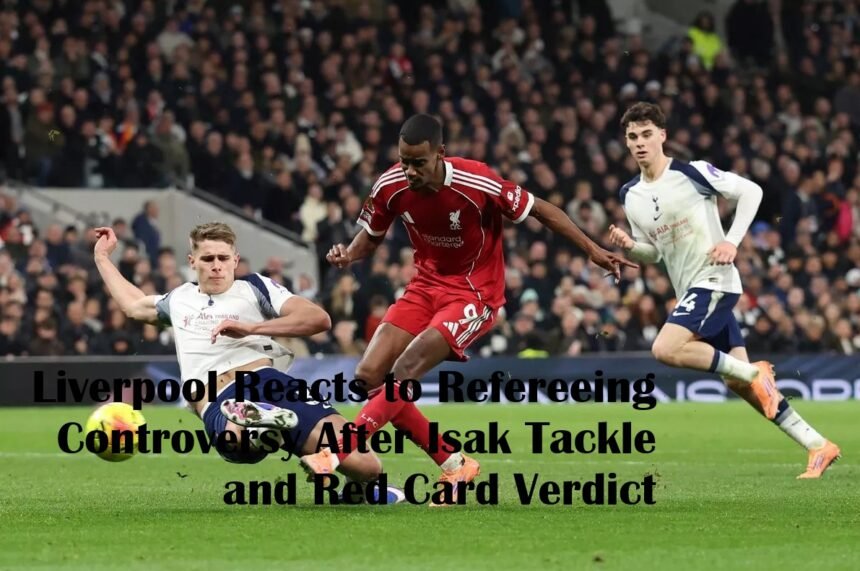
Liverpool’s football team has been thrust into the spotlight again after a controversial incident involving striker Alexander Isak and a referee’s decision that left many in the sport astonished. The dispute centers on a tackle that left Isak injured and raised questions about how referees and VAR officials interpret key moments in Premier League matches.
At the heart of the debate is a challenge from Tottenham Hotspur defender Micky van de Ven, which connected with Isak’s leg immediately after the striker had scored his team’s opening goal. Although the goal stood, the challenge drew fierce reaction from fans, commentators, and some experts, who felt that it merited much stronger action from match officials.
In Liverpool’s camp, frustration has been clear. The club has voiced concerns about how referees are applying the Laws of the Game in high-impact situations. Many supporters have echoed these concerns, arguing that dangerous tackles should be penalised consistently and that player safety must be paramount, especially when incidents result in serious injury.
The Incident That Sparked Outrage
The specific challenge on Isak occurred during a hard-fought Premier League clash at Tottenham. Liverpool had taken the lead when Isak finished a composed move just 11 minutes after entering the pitch at halftime.
His strike gave Liverpool an edge in a contest already marked by disciplinary drama, including Tottenham midfielder Xavi Simons being dismissed after a VAR review earlier in the match. Almost immediately after the goal, Isak went down in visible pain following van de Ven’s sliding challenge.
The defender’s lunge missed the ball and appeared to connect heavily with Isak’s ankle or lower leg. Despite the severity of the contact, no card or further review was issued for the challenge itself. This lack of action surprised many, especially given the attention referees now receive for player safety issues.
Reactions From Within the Game
Liverpool players and staff were visibly upset. Teammates and supporters alike questioned why the tackle wasn’t checked more thoroughly by the officials. Fan reactions on social media showed a high level of disbelief and anger, with many calling for stricter enforcement of reckless challenges like the one that affected Isak.
While Klopp’s direct quotes are not suitable here, it is widely observed within the football community that managers often express frustration over inconsistent referee decisions. Liverpool’s camp has consistently pushed for clearer and more predictable officiating standards, an issue that has been raised more broadly across the Premier League.
Official Verdict and Astonishment
What truly amplified the controversy was how officials responded after the game. While some incidents in football receive corrective statements or clarification from refereeing bodies, this situation was met with a relatively muted official response.
Many observers were astonished that no retrospective punishment was issued for what appeared to be a dangerous tackle, especially one linked to a potentially significant injury to a key player like Isak. Moreover, the absence of a formal statement from the refereeing authority led to broader discussion among supporters and pundits.
They highlighted a gap between what is expected in terms of player protection and how decisions are ultimately handled in matches. Critics pointed to the lack of action as an example of inconsistency in officiating, especially in comparison to situations where VAR upgrades decisions to red cards for high tackles or similar situations.
Liverpool’s Defensive Worries Grow
Beyond the refereeing debate, Liverpool now faces a major concern regarding Isak’s fitness. After being helped off the pitch, the striker underwent scans, which ruled out an ACL tear, but the club still fears he has suffered a serious lower leg injury that could sideline him for months.
Magnetic Resonance Imaging (MRI) tests are awaited to confirm the full extent, yet early assessments from inside the club are pessimistic. This development has significant implications for Liverpool’s season. With Isak expected to miss a substantial period, the team’s forward options are now stretched.
Key attackers, in addition to Isak, such as Mohamed Salah and Cody Gakpo, are already unavailable due to international duty or other injuries. This places additional pressure on the squad and may force managerial adjustments or changes to transfer strategy in the January window.
The Bigger Conversation: Refereeing Standards
The Isak incident has reignited debate about refereeing standards across the Premier League. Many feel that decisions lack uniformity and that player welfare sometimes takes a backseat to game flow or traditional interpretations.
Refereeing discussions are part of an ongoing conversation in modern football, involving VAR protocols, pitch-side review processes, and how clear and obvious errors should be handled. Premier League officials have repeatedly stated that they strive for consistency and accuracy.
However, the challenge faced by Liverpool and its supporters highlights a broader concern, that interpretation and enforcement can vary widely from game to game. The need for transparent guidelines, especially on dangerous play and injury-related situations, has never been more pressing in the sport.
Looking Ahead
For Liverpool, the focus will now shift back to results and rebuilding momentum without one of their most valuable forwards. The club’s reaction to the referee’s decision and its broader implications could shape future discussions on officiating practices.
Whether this situation triggers any procedural changes remains uncertain, but it has undoubtedly added fuel to an already heated debate among fans, players, and pundits alike. Liverpool’s emphasis remains on resilience and adaptation. With a demanding fixture list ahead, the team must find a way to cope with setbacks both on and off the pitch.
The Isak situation serves as a reminder of football’s unpredictable nature, where a single incident can impact not only the outcome of a game but also the wider narrative around fairness, safety, and competitive integrity.