



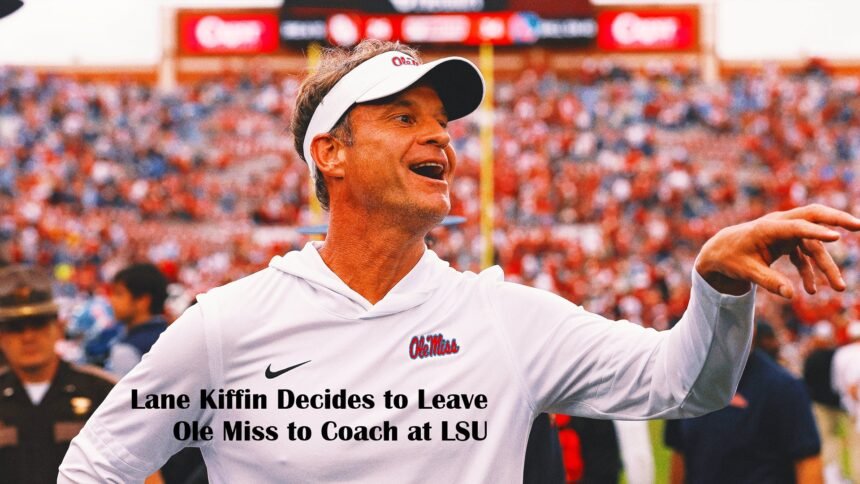
Lane Kiffin has decided to leave Ole Miss after six seasons as head coach. He will take over as head coach at LSU beginning immediately. The decision was announced publicly on social media on Sunday. In a message to fans, Kiffin said that accepting the job at LSU was a “difficult decision.”
He added that while he looked forward to a fresh start and unique opportunities there, he would “forever cherish the incredible six years” spent at Ole Miss.
A High-Water Mark at Ole Miss
Under Kiffin’s guidance, Ole Miss reached its best season in more than six decades. The team posted an impressive 11–1 record and secured what is expected to be the school’s first berth in the College Football Playoff. During his tenure, Ole Miss achieved consistent success: the program earned at least 10 wins in four of the past six seasons and appeared in five straight bowl games.
The final game that Kiffin coached was the annual rivalry game known as the Egg Bowl, a 38–19 victory over in-state rival Mississippi State Bulldogs on Friday, Nov. 28, 2025, in Starkville. That game marked the end of his Ole Miss coaching stint.
Controversy Over Playoff Coaching Transition
Kiffin had requested permission to remain as Ole Miss’s coach through the playoffs, a wish supported by some players and staff, according to his statement. However, Ole Miss athletic director Keith Carter denied the request. As a result, Friday’s Egg Bowl became Kiffin’s last game with the Rebels.
Following the departure, Ole Miss immediately promoted defensive coordinator Pete Golding to head coach. Golding will lead the team through the playoffs and beyond. In his social-media message, Kiffin expressed disappointment at not being allowed to see the season through but affirmed support for the program and hope that the team would “bring a championship to Oxford.”
LSU’s New Era: Why Kiffin Took the Job
LSU will become the fifth college head coaching post in Kiffin’s career. His previous stops included head-coaching roles at the Tennessee Volunteers, USC Trojans, and Florida Atlantic Owls before leading Ole Miss. The LSU job appeals to Kiffin for multiple reasons.
He described the opportunity as “unique,” implying that the resources, expectations, and legacy at LSU provide a chance to compete at the highest levels. LSU’s program history, including multiple national championships and a tradition of producing elite-level players, likely factored into Kiffin’s decision. The move is being seen as a significant shift in college-football coaching dynamics.
What It Means for Both Programs
For Ole Miss, the abrupt loss of Kiffin ahead of the playoffs introduces uncertainty. The program will rely on Pete Golding to maintain momentum in pursuit of its first national title. The transition came quickly and immediately. For LSU, a new era begins under Kiffin’s leadership.
The expectations will be high, given the program’s legacy and the fact that Kiffin joins as one of the sport’s experienced coaches with a strong recent track record.
As Kiffin transitions, questions remain regarding how smoothly LSU adapts, how Ole Miss deals with the mid-season coaching change, and whether players or staff will follow him to Baton Rouge. The coming months will reveal how impactful this decision will be for each program.
Conclusion
Lane Kiffin’s departure from Ole Miss, leaving behind a program at the peak of performance, and his acceptance of the head coaching role at LSU marks a major shakeup in college football ahead of the postseason. The move closes a successful chapter in Oxford and launches a new one in Baton Rouge.
While the decision sparked controversy due to timing, it underscores the high-stakes, high-reward nature of coaching in top-tier college football. What remains to be seen is whether this gamble will pay off for Kiffin, for LSU, and for the Rebels left behind.