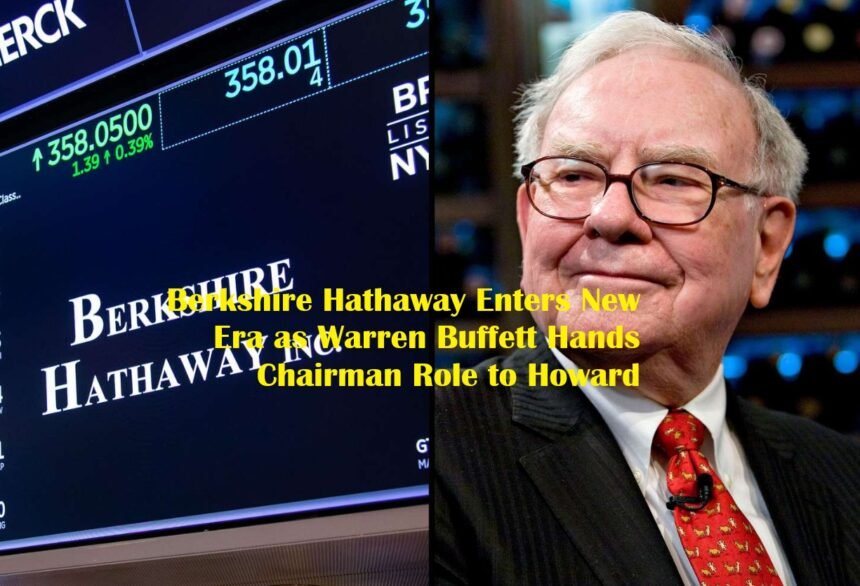
Berkshire Hathaway has entered a new chapter after Warren Buffett stepped away from the company’s chairmanship, completing another major stage of the succession process at the $1.1 trillion conglomerate. The company announced on September 18 that Buffett would immediately become chairman emeritus while remaining a member of Berkshire’s board.
His eldest son, Howard G. Buffett, has been elected chairman of the board, while Greg Abel continues to run the company as chief executive officer. The leadership arrangement separates Berkshire’s operational management from its responsibility for preserving the corporate culture that Buffett developed over more than six decades.
A Succession Plan Moves Into Its Next Phase
Buffett’s departure from the chairman position was not unexpected. Berkshire had already taken an important step toward a post-Buffett structure when Greg Abel assumed the CEO role at the beginning of 2026. The latest announcement completes another part of that transition. Rather than transferring both the company’s executive and board leadership to one person, Berkshire has divided the responsibilities between Abel and Howard Buffett. Abel is responsible for running the conglomerate and overseeing its collection of businesses.
Howard Buffett, meanwhile, will serve as a non-executive chairman whose principal responsibility is maintaining the culture and values associated with Berkshire. Berkshire said Warren Buffett will continue to contribute his judgment and perspective as a board member despite no longer serving as chairman.
Howard Buffett Takes a Different Kind of Role
Howard Buffett has been a Berkshire director since 1993, giving him more than three decades of experience with the company and its governance. His appointment does not mean he will take over day-to-day management. Instead, the new chairman is expected to act as a guardian of Berkshire’s corporate philosophy. That distinction is important because Berkshire operates differently from many large conglomerates. Its numerous businesses including insurance, energy, rail transportation, manufacturing, services and retail operate with substantial autonomy.
Howard Buffett has previously described the company’s culture in terms of simplicity, fairness, respect for managers and shareholders, and transparency about problems. Those principles are expected to remain relevant as the company moves beyond Warren Buffett’s direct leadership.
Greg Abel Controls the Operational Side
While Howard Buffett takes the chairmanship, Greg Abel remains the central figure responsible for Berkshire’s business operations. Abel joined Berkshire through its acquisition of MidAmerican Energy in 2000 and eventually became responsible for a broad collection of the company’s non-insurance businesses. He was selected as Buffett’s successor as CEO before taking the position in January 2026. His responsibilities include overseeing major operations such as BNSF Railway, Berkshire Hathaway Energy and various industrial and consumer businesses.
The separation between Abel’s executive role and Howard Buffett’s board position creates a leadership structure in which operational decisions remain with an experienced executive while the board chairman focuses heavily on governance and cultural continuity.
Buffett’s Influence Remains Part of Berkshire
Although Buffett no longer holds the chairman position, his connection with Berkshire has not ended. The 96-year-old investor will remain on the board and continue offering his perspective. That gives Berkshire access to his experience while allowing the company’s new leadership structure to operate independently.
Buffett joined Berkshire in 1965 and transformed what had been a struggling textile business into a diversified conglomerate with operations spanning insurance, transportation, energy, manufacturing, retail and other industries. Berkshire’s market value surpassed $1 trillion in 2024, making it one of the largest companies in the United States outside the technology sector.
His investment approach also became closely associated with Berkshire’s identity. Long-term ownership, disciplined capital allocation and allowing managers to operate independently became important elements of the company’s reputation.
Investors Watch the Post-Buffett Era
The leadership transition is also significant for Berkshire shareholders because Buffett’s presence has historically been closely linked with investor confidence. Reuters reported that Berkshire’s Class B shares were down 0.3% in premarket trading following the announcement.
The company’s price-to-book ratio had also declined from around 1.62 to 1.53 since Buffett announced his departure as CEO, according to LSEG data. Those market movements illustrate the attention investors continue to place on Berkshire’s transition. However, the company enters the new era with a succession plan that has been developed over many years.
What Comes Next for Berkshire Hathaway?
Berkshire’s post-Buffett structure now has three distinct elements: Abel leads the business, Howard Buffett oversees the board and cultural continuity, while Warren Buffett remains available as a director and source of experience. The arrangement allows Berkshire to move forward without completely severing its connection to the person who shaped the company for more than 60 years.
For investors, the focus will gradually shift from Buffett’s personal leadership to how effectively Berkshire’s broader management team maintains its decentralized business model, capital allocation discipline and long-term approach. The September 18 announcement therefore represents more than a change in a corporate title. It marks another step in Berkshire Hathaway’s carefully prepared transition from the Buffett era toward a leadership structure designed to operate without Warren Buffett at the center of its daily governance.