



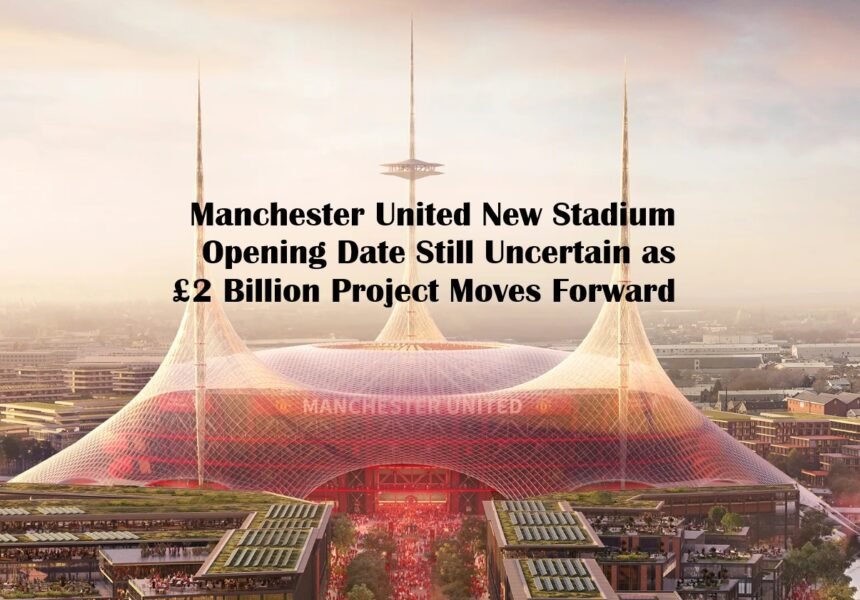
Manchester United supporters are still waiting for a definitive answer to one major question, when will the club actually leave Old Trafford and move into its planned new stadium? The project has become one of the most ambitious developments in English football. Manchester United intends to build a new 100,000-capacity stadium close to the existing Old Trafford, creating a new home that could reshape both the club and the surrounding Trafford area. However, despite substantial progress behind the scenes, an official opening date has yet to be firmly established.
Recent reports suggest the stadium could take several years to complete, with some documentation pointing toward 2035 as a possible completion date. That timeline is later than the club’s previously discussed ambition of opening the venue during the 2032-33 season.
Why the Opening Date Remains Unclear
The proposed stadium is part of a much larger regeneration programme around Old Trafford rather than an isolated construction project. Manchester United’s leadership has repeatedly presented the development as an opportunity to transform the area surrounding the club’s historic home. That means the timeline depends not only on stadium construction but also on land, infrastructure, transportation and wider regeneration plans.
Club CEO Omar Berrada recently confirmed that work on the project is continuing. He also said Manchester United would maintain discussions with supporters as plans develop, particularly following the decision to establish a new site for the stadium. The uncertainty surrounding the completion date therefore reflects the scale of the project. Building a stadium capable of accommodating 100,000 spectators requires extensive preparation before construction can reach its final stages.
A 100,000-Seat Venue Next to Old Trafford
The proposed stadium would be constructed approximately 350 metres northwest of the current Old Trafford. Manchester United has secured most of the land required for the development, removing one of the major obstacles that had previously affected the project’s progress. The venue is expected to hold around 100,000 spectators, making it substantially larger than the existing Old Trafford, which currently accommodates more than 74,000 fans.
The new design was developed by Foster + Partners and forms part of Manchester United’s broader plan to create a modern sporting and commercial destination. Earlier plans described a major canopy structure covering the stadium and surrounding public spaces. The project has been estimated at around £2 billion, underlining the financial scale of the development. The club has also moved toward private financing rather than relying on public funding for the stadium itself.
Old Trafford Will Remain Important
Although Manchester United is planning a new stadium, Old Trafford’s role in the club’s future has not simply disappeared. The existing ground has been the club’s home since 1910 and remains central to Manchester United’s identity. The proposed development is designed to provide a new main stadium while contributing to the regeneration of the surrounding district. This approach could allow the club to preserve elements of its existing history while creating a much larger venue designed for modern football and entertainment requirements.
The current stadium has undergone several upgrades over the decades, but its most recent major expansion occurred around two decades ago. The proposed new venue represents a much more substantial transformation than another conventional refurbishment.
2035 Women’s World Cup Adds Another Deadline
The stadium’s potential completion has also attracted attention because Manchester United wants the new venue to be considered for the 2035 Women’s World Cup. The tournament is expected to use multiple venues across the United Kingdom, with Old Trafford already among the proposed locations under consideration if the new stadium is completed in time. Manchester United has expressed an ambition for its new ground to host major international matches, potentially including the tournament final.
However, reports indicate that a construction period of up to 10 years could make the timing more challenging. That makes the stadium’s construction schedule particularly significant. Any major delay could affect not only Manchester United’s plans but also the venue’s potential involvement in one of the biggest international women’s football tournaments.
What Happens Next?
For now, Manchester United supporters should expect the stadium project to remain a long-term development rather than an imminent move. The club has already secured significant land and identified the proposed location, while senior executives continue to discuss the next stages with supporters. These developments indicate that the project has moved beyond the purely conceptual stage, but a confirmed opening date remains outstanding. Earlier ambitions pointed toward the 2032-33 season, while more recent reports have raised the possibility of completion closer to 2035.
Until Manchester United publishes a definitive construction timetable, both dates should be treated as targets or reported projections rather than confirmed opening dates. For Manchester United, the challenge now is turning an enormous architectural and regeneration vision into a completed stadium. The eventual move from Old Trafford will depend on how quickly construction, infrastructure and surrounding development can progress over the coming years.