



Artificial intelligence continues to reshape the global banking industry. Major financial institutions now integrate AI into operations, customer service, compliance, and investment analysis. As this transition accelerates, many banks also reduce their workforce to cut costs and improve efficiency.
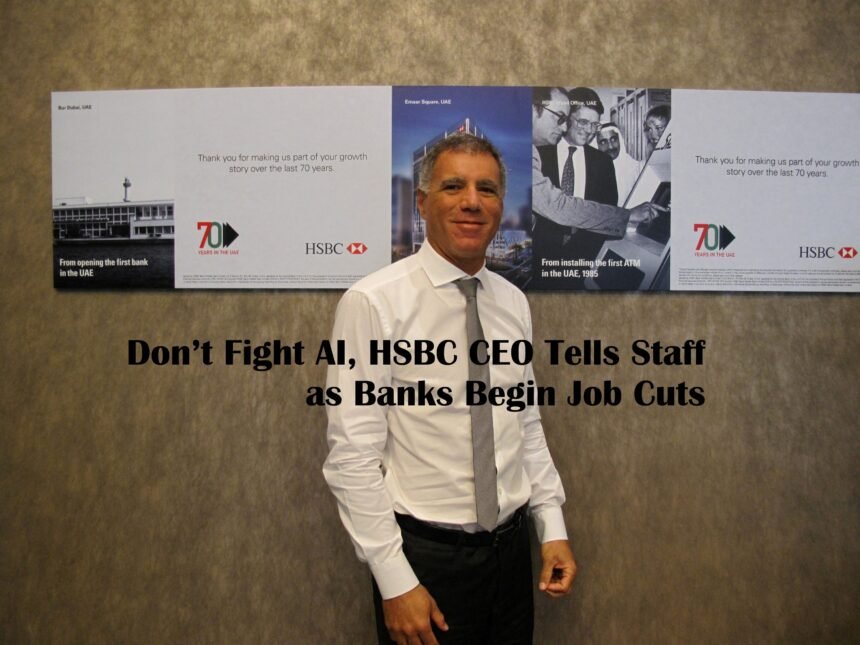
HSBC CEO Georges Elhedery recently urged employees to embrace artificial intelligence instead of resisting it. His comments came during a period of growing concern about job losses across the banking sector. Financial companies increasingly rely on automation to replace repetitive tasks and streamline decision-making.
The message reflects a larger shift happening inside global finance. Banks no longer treat AI as a future experiment. Executives now view the technology as a core business tool that will shape competitiveness for years ahead.
HSBC Pushes Employees to Adapt
Georges Elhedery encouraged HSBC workers to develop skills that complement AI systems. He warned employees against resisting technological change. According to him, adaptation remains essential for long-term career growth in banking. The CEO explained that AI can improve productivity and reduce operational complexity.
He also stressed that human judgment still matters in areas such as relationship management, risk evaluation, and strategic planning. HSBC already uses AI tools across multiple departments. These systems support fraud detection, document analysis, customer interactions, and market research.
The bank believes broader AI integration will strengthen efficiency and profitability in the coming years. At the same time, employees worry about the future of traditional banking jobs. Many workers fear that automation could replace positions involving data entry, processing, and administrative support. Those concerns continue spreading throughout the financial sector.
Banking Industry Begins Workforce Reductions
Several major banks recently announced layoffs while increasing investments in artificial intelligence. Executives argue that automation can handle tasks faster and at lower cost than large human teams. Banks face pressure from shareholders to improve margins during uncertain economic conditions. AI offers opportunities to reduce expenses while maintaining service quality.
As a result, many institutions now redesign workforce structures around technology-driven operations. Analysts expect entry-level and back-office roles to face the highest risk. AI systems can process documents, review transactions, and generate reports within seconds.
Tasks that once required entire departments now need far fewer employees. Some banks have already reduced hiring for junior positions because AI tools cover basic analytical work. Industry leaders believe this trend will continue over the next decade as technology improves further.
Despite these cuts, banks still need skilled professionals who understand both finance and artificial intelligence. Demand continues to grow for workers specializing in cybersecurity, machine learning, compliance oversight, and digital transformation.
AI Changes the Nature of Banking Jobs
Artificial intelligence not only eliminates tasks. It also changes how employees perform their work each day. Bankers now rely on AI-powered systems to analyze data, identify trends, and support decision-making. Relationship managers use AI tools to understand customer behavior more accurately.
Investment teams apply machine learning models to study market movements and risk patterns. Compliance departments depend on automation to monitor suspicious activities and regulatory issues. This transformation forces workers to learn new skills quickly. Employees who understand data analysis and AI collaboration may gain stronger career opportunities.
Workers who ignore technological change could struggle to remain competitive. Training and reskilling, therefore, become major priorities for global banks. Many institutions now offer internal education programs focused on digital tools and AI literacy.
HSBC also encourages employees to strengthen technical capabilities alongside traditional banking expertise. Executives believe future banking jobs will combine human judgment with AI assistance rather than rely entirely on manual processes.
Cost Pressure Accelerates Automation
Banks worldwide continue facing economic pressure from rising competition, changing regulations, and slower global growth. Many institutions seek ways to improve efficiency without reducing customer service. Artificial intelligence offers a solution because it can automate repetitive processes and lower operational expenses.
Technology investments often cost less than maintaining large teams over the long term. Financial firms also compete with fintech companies that already use advanced automation. Traditional banks, therefore, accelerate digital transformation efforts to avoid losing market share. HSBC has pursued broader restructuring under Georges Elhedery’s leadership.
The bank aims to simplify operations and focus on profitable business areas. AI integration supports those objectives by reducing inefficiencies and improving productivity. Other global banks follow similar strategies. Many executives now describe AI as essential for long-term survival in modern finance.
Employees Remain Concerned About Job Security
Although executives highlight productivity benefits, employees remain anxious about workforce reductions. Many banking workers worry that automation could permanently shrink employment opportunities in the sector. Entry-level professionals face particular uncertainty because AI increasingly handles routine analysis and reporting tasks.
Graduates entering finance may encounter fewer traditional career pathways than previous generations. Some labor experts warn that rapid automation could widen inequality inside corporate organizations. Highly skilled workers may gain stronger salaries and opportunities, while lower-skilled employees face greater displacement risks.
Others argue that AI will create new roles even as it removes older ones. Technology transitions throughout history often eliminated certain jobs while generating demand for different skills.
Supporters believe banking will follow a similar pattern. Still, adaptation may prove difficult for many workers. Employees need continuous learning to remain valuable in rapidly evolving workplaces.
Regulators Watch AI Expansion Closely
Financial regulators also monitor the growing use of artificial intelligence inside banks. Authorities want to ensure automated systems operate fairly, securely, and transparently. AI tools can sometimes produce inaccurate results or biased recommendations if developers fail to monitor them properly.
Regulators, therefore, expect banks to maintain strong oversight and human accountability. Cybersecurity risks also increase as financial firms depend more heavily on digital infrastructure. Banks must protect customer data while defending systems against hacking and fraud attempts. Industry leaders acknowledge these concerns but argue that responsible AI governance can reduce risks.
Many institutions now establish internal ethics teams and oversight frameworks for AI deployment. HSBC stated that human supervision remains important even as automation expands. The bank believes technology should support employees instead of replacing all human involvement.
The Future of Banking Will Depend on Adaptation
Artificial intelligence will likely remain a defining force in global finance for many years. Banks continue investing billions of dollars into automation, analytics, and digital transformation projects. The industry now enters a transition period where human workers and AI systems operate side by side.
Success will depend on how effectively banks balance efficiency with employee development and customer trust. Georges Elhedery’s message to HSBC staff reflects a broader reality across modern finance. Employees can no longer ignore technological change.
Workers who adapt and develop new skills may find strong opportunities in the evolving banking landscape. At the same time, banks must manage workforce reductions carefully to avoid damaging morale and public reputation. Responsible leadership will play an important role as automation spreads further across the sector.
The rise of AI in banking no longer represents a distant possibility. It already shapes hiring decisions, daily operations, and long-term corporate strategies. The institutions that adapt fastest may gain major advantages in the increasingly digital future of finance.