



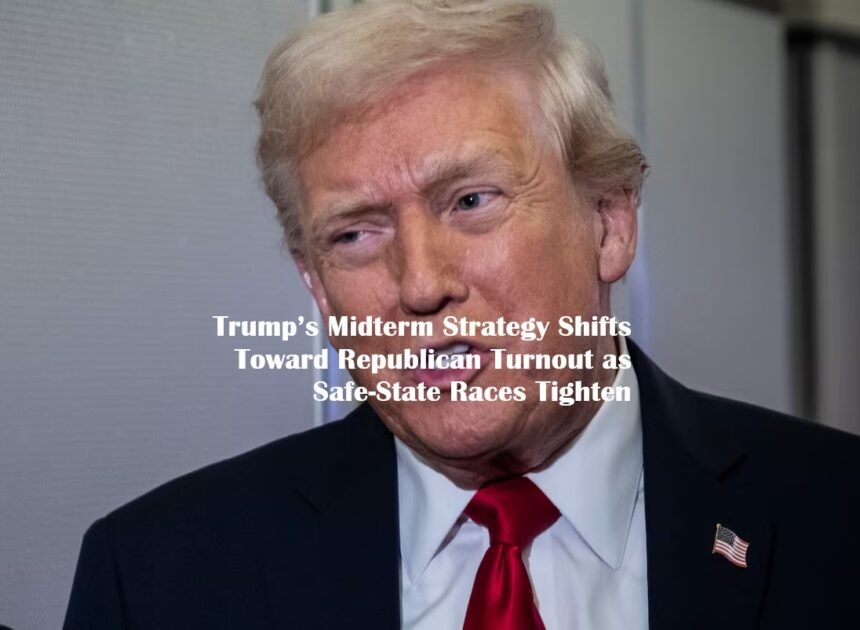
President Donald Trump is preparing for a more active role in the 2026 U.S. midterm campaign, but his upcoming travel schedule is drawing attention for where he is choosing to appear. Rather than immediately concentrating on the most competitive congressional contests, Trump is beginning the next phase of his campaign with events in strongly Republican states.
The itinerary highlights a central challenge for Republicans heading into the November elections: maintaining enthusiasm among the party’s core supporters while candidates in traditionally Republican territory face increasingly competitive political environments.
Trump previously said he intended to campaign in roughly 35 of the most competitive races before Election Day. Yet his planned appearances in Alabama and Oklahoma suggest that Republican turnout and candidate support in states normally considered safer are also becoming important parts of the party’s strategy.
Red States Become Part of the Midterm Battle
Trump is scheduled to hold rallies in Mobile, Alabama, and Durant, Oklahoma, as October begins. Both states have strong Republican voting histories, making them different from the traditional swing-state targets that usually receive most of the attention during national elections. The choice of locations does not necessarily mean the contests are comparable with closely divided states.
Instead, the events can serve multiple purposes, including strengthening turnout, supporting individual Republican candidates and generating attention across nearby media markets. The Alabama event also carries personal significance for Trump. Mobile was the site of one of his early large-scale rallies during his first presidential campaign, when he was still establishing himself as a major force within Republican politics.
Oklahoma presents a different situation. Trump is supporting Republican gubernatorial candidate Mike Mazzei, who emerged from a competitive primary and is now facing Democrat Cyndi Munson in the general election. The Democratic Governors Association has described the contest as becoming more competitive, although that characterization comes from a Democratic campaign organization and should be understood in that context.
Republican Candidates Are Facing Local Political Pressures
Trump’s involvement comes as several Republican candidates attempt to balance their relationship with the president and their own state-level political circumstances. Some Republicans have recently created more distance from Trump on individual issues, particularly immigration and the economic consequences of the Iran conflict.
In Florida, Republican Rep. Maria Salazar released an advertisement criticizing parts of Trump’s immigration enforcement approach. In Kansas, Republican Sen. Roger Marshall also raised concerns about the way Immigration and Customs Enforcement operations were being conducted in his state.
These developments illustrate the different calculations Republican candidates face. Trump remains a major figure within the party, but candidates must also respond to local voters, state-specific issues and their own political constituencies.
Economic Issues Complicate the Campaign
The cost of living is another important factor heading into the midterms. The ongoing U.S.-Iran conflict has disrupted energy markets and contributed to higher fuel prices, creating an issue that reaches voters beyond traditional foreign-policy debates. Reuters reported that Trump was dealing with weak approval ratings amid inflation concerns and the economic effects of the conflict. Republican lawmakers in states such as Iowa have publicly addressed the impact of energy costs on households.
Iowa Republican Rep. Ashley Hinson, for example, criticized the economic burden created by high prices while maintaining her position regarding congressional involvement in Trump’s war policies. Her race is among those receiving increased attention as Republicans defend seats that have historically been more secure.
Turnout Could Become a Central Objective
Trump’s campaign role extends beyond individual candidates. His appearances can help Republican organizations energize supporters who may be less motivated to vote during a midterm election than during a presidential contest. The president himself has framed the 2026 election as closely connected to his administration. At a Republican midterm convention earlier this month, Trump urged supporters to treat the election as if he were personally on the ballot.
Republican strategists therefore have to consider two related objectives, persuading undecided voters and ensuring that established Republican supporters participate. Trump’s rallies are particularly suited to the second objective because they allow him to communicate directly with his political base while providing local candidates with access to national attention.
Why Iowa and Other Competitive States Still Matter
Although Trump’s immediate itinerary emphasizes Alabama and Oklahoma, competitive races elsewhere remain central to the broader Republican campaign. Iowa has become one example of how previously reliable Republican territory can still generate significant campaign activity.
Vice President JD Vance recently traveled to a deeply Republican part of the state, with advisers describing the visit as an effort to encourage Trump’s supporters to turn out. Other states also feature Senate and House races where Republican candidates are dealing with tighter contests than party leaders might have expected earlier in the cycle. This means Trump’s travel schedule should not be viewed solely as a list of states where Republicans face their greatest electoral competition. It also reflects an effort to reinforce the party’s broader organizational network.
The Road to November
Trump has promised an extensive campaign schedule before the November 3 midterm elections, with an emphasis on congressional races and selected gubernatorial contests. Reuters reported earlier in September that Trump had identified about 35 key races as priorities for his campaign activity.
His decision to begin the next phase in Alabama and Oklahoma adds another dimension to that strategy. For Republicans, the coming weeks will involve managing several competing priorities, maintaining support for Trump, addressing economic concerns, defending vulnerable seats and encouraging turnout in states where the party normally enjoys an advantage.
The eventual significance of Trump’s campaign stops will depend on how individual races develop and how voters respond to national and local issues. For now, his itinerary shows that the Republican midterm effort is not limited to traditional battlegrounds. It also includes efforts to reinforce support in states where the party has historically held substantial strength but where individual contests have become more closely watched.