



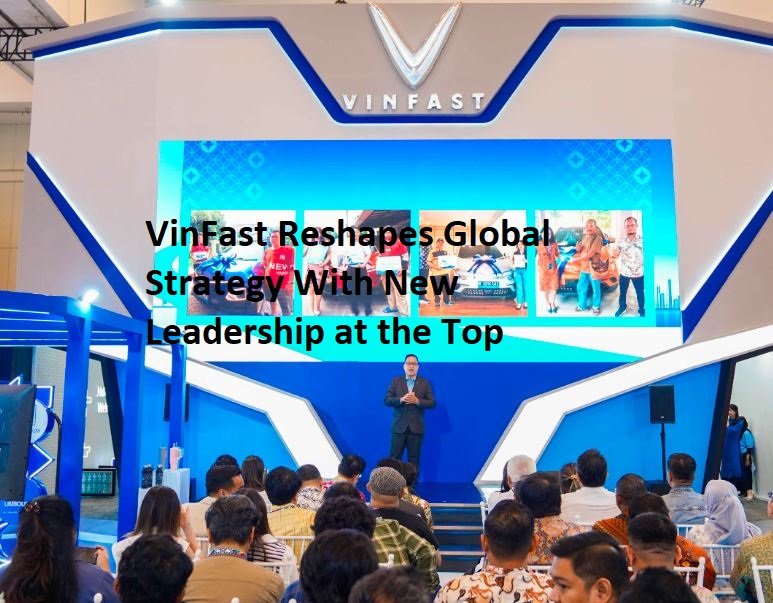
VinFast is entering a crucial stage in its international expansion with a major change at the top of the Vietnamese electric vehicle maker. The company has appointed 33-year-old Pham Nhat Quan Anh as global chief executive, placing the founder’s eldest son in charge as VinFast attempts to strengthen its business model and expand beyond its home market. The leadership transition comes at a particularly important moment.
VinFast continues to report losses despite growing revenue, while management is pursuing a restructuring designed to reduce capital requirements. At the same time, the company is targeting growth opportunities across Southeast Asia and India. The appointment therefore represents more than a change in executive personnel. It places a younger generation of leadership at the center of VinFast’s next phase of global development.
A New Executive Takes Control
Quan Anh, the eldest son of VinFast founder Pham Nhat Vuong, has already held several senior positions within VinFast and the wider Vingroup business empire. He became global chairman of VinFast in May and also serves as chief executive of VinFast Vietnam.
Following the latest announcement, he will take responsibility for the company’s global operations while continuing to lead its Vietnamese business. His father will remain involved as a member of VinFast’s board rather than disappearing from the company entirely.
The change effectively separates day-to-day executive leadership from the founder while preserving his influence at the board level. Quan Anh’s appointment also makes him the fifth chief executive to lead VinFast.
Previous executives included former General Motors executive James DeLuca, former Opel chief Michael Lohscheller and Le Thi Thu Thuy, who guided the company during its Nasdaq listing.
Global Expansion Becomes the Central Challenge
VinFast is looking beyond Vietnam for its next major growth engine. The company has identified Southeast Asia and India as important markets, with India receiving particular attention.
VinFast opened its first manufacturing facility outside Vietnam in India and has pledged approximately $2 billion toward developing its operations there. However, the company’s approach to India has recently changed.
VinFast suspended plans to manufacture three existing global models locally after determining that production costs would make them difficult to sell at competitive prices.
Instead, the company is developing two India-focused EVs that could better match local consumer preferences and price expectations. That strategic adjustment illustrates the challenge awaiting Quan Anh.
International expansion will require VinFast to adapt products and manufacturing strategies to individual markets rather than simply exporting its existing vehicle lineup.
Restructuring Aims to Reduce Financial Pressure
VinFast’s leadership change also arrives alongside a significant corporate restructuring. The company has been moving toward a more asset-light operating model.
Under the restructuring plan, manufacturing assets worth approximately $530 million are expected to be transferred to a buyer group that would also assume around $6.9 billion in debt.
The objective is to reduce the amount of capital VinFast needs to commit to manufacturing operations while giving the company greater flexibility to concentrate on vehicle development, sales and international expansion.
However, the structure of the transaction and the involvement of parties connected with Vingroup and Vuong have generated concerns among some analysts and shareholders. For the new CEO, improving financial efficiency will be just as important as increasing vehicle sales.
Revenue Is Growing, But Losses Remain
VinFast has demonstrated signs of commercial progress, but profitability remains a major hurdle. The automaker reported first-quarter revenue growth of nearly 42%.
Despite the stronger top line, the company recorded a wider net loss. The business has also continued receiving financial support from Vuong, who founded Vingroup, Vietnam’s largest conglomerate and VinFast’s parent company.
This combination of rising revenue and continued losses creates pressure for management to demonstrate that expansion can eventually translate into sustainable profitability.
A Family Leadership Transition Across the Group
Quan Anh’s appointment is not the only leadership change involving Vuong’s family. His younger brother, Pham Nhat Minh Hoang, was also named global CEO of GSM, the VinFast-linked electric taxi company.
GSM is preparing for a potential Hong Kong listing in 2028 and plans to purchase approximately 1 million electric vehicles and 4 million electric scooters from VinFast between 2026 and 2030. The developments suggest that the next stage of Vingroup’s mobility strategy will increasingly involve the founder’s sons in senior management roles.
VinFast’s Next Test
Quan Anh inherits a company with significant ambitions but equally significant challenges. VinFast must expand internationally without allowing capital requirements and operating losses to grow uncontrollably.
India offers substantial potential, but competition is intense, while Southeast Asian markets are also attracting global and Chinese EV manufacturers. The new CEO’s immediate task will therefore be balancing growth with financial discipline.
If VinFast can successfully develop competitive products, control manufacturing costs and build sustainable demand overseas, the leadership transition could mark the beginning of a more mature phase for the company.
For now, the appointment signals a clear shift in strategy: VinFast is preparing to move from founder-led expansion toward a new generation of management focused on turning international ambitions into a financially sustainable EV business.