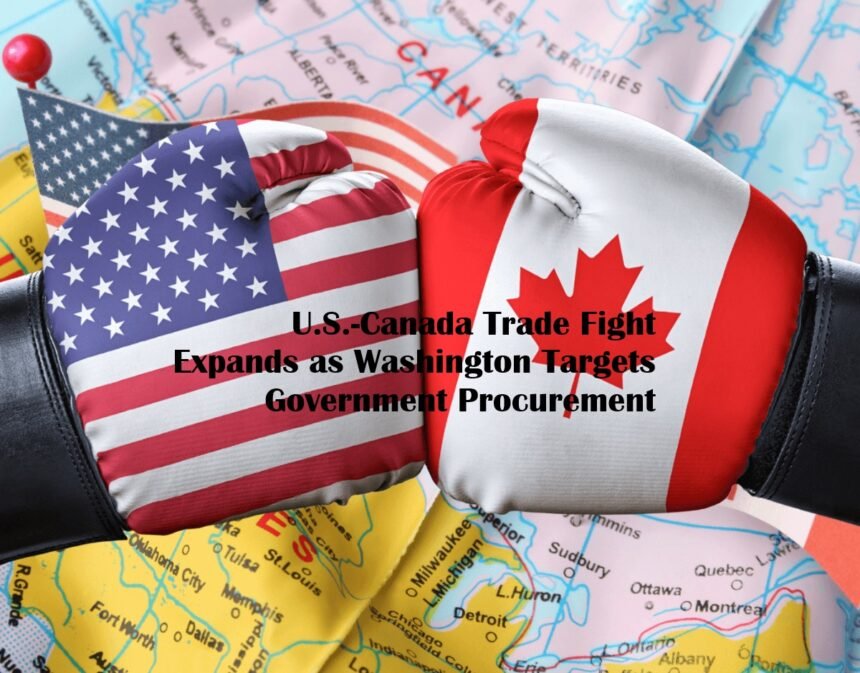
The trade dispute between the United States and Canada has entered a new phase, moving beyond tariffs and into the government purchasing market. President Donald Trump has ordered the U.S. government to begin restricting access for Canadian products and companies to federal procurement programs, adding another layer of pressure on Ottawa as both countries exchange increasingly aggressive trade measures.
The move comes after Canada introduced retaliatory tariffs covering roughly $20 billion of U.S. goods. Washington now appears determined to use federal purchasing power as another bargaining tool in its broader effort to force Canada to change its trade policies.
Procurement Becomes Washington’s Latest Trade Weapon
The administration’s latest action focuses on the General Services Administration, or GSA, which operates one of the federal government’s largest purchasing systems. Trump directed the GSA, working with the U.S. Trade Representative, to take steps toward removing Canadian-origin products from the agency’s Multiple Award Schedules. These schedules allow government agencies to purchase a wide range of goods and services from preapproved suppliers. For Canadian companies, losing access to this system could create a significant commercial obstacle.
Government contracts can provide suppliers with long-term demand and predictable revenue, making federal procurement an important market for businesses operating across North America. Trump framed the policy around what he described as a lack of equal access for American businesses in Canadian government procurement.
The administration argues that Canadian federal and provincial governments have restricted American small businesses and farmers from competing for certain public-sector opportunities. The White House therefore presented the procurement restrictions as a response designed to restore what Trump calls “full and fair reciprocity.”
Canadian Retaliation Raises the Stakes
The procurement decision follows a fresh round of Canadian tariffs that took effect September 8. Ottawa imposed duties ranging from 15% to 50% on approximately $20 billion of U.S. products, targeting categories that include steel, appliances, agricultural equipment and electronics. Canada introduced the measures after Washington imposed broad tariffs on Canadian goods, escalating a dispute that has already disrupted the traditional trading relationship between the two countries.
The latest exchange demonstrates how quickly the conflict is spreading across different areas of commerce. What began primarily as a dispute over tariffs is now affecting procurement policies, imported consumer goods and individual industries. That broader scope could make negotiations more difficult because businesses on both sides are increasingly exposed to government decisions.
Canadian Companies Face a New Barrier
The restrictions on government procurement could be particularly important for Canadian manufacturers and suppliers that depend on U.S. public-sector customers. Unlike a standard tariff, which increases the cost of imported goods, procurement restrictions can prevent a foreign supplier from competing for certain contracts altogether. That distinction makes the latest measure potentially more consequential for companies whose business models rely heavily on government buyers.
The policy could also encourage Canadian businesses to reconsider their exposure to the U.S. market. Canada has historically depended heavily on American demand, while supply chains between the two countries remain deeply interconnected. Canadian officials have already signaled a desire to strengthen the country’s economic independence and diversify trade relationships. More restrictions from Washington could accelerate that strategy.
Pressure Extends Beyond Procurement
The government-contract restrictions are only one element of the latest escalation. Trump has also announced measures targeting Canadian dairy products, alcoholic beverages and motorcycles, with the new import bans scheduled to take effect later in September. The administration has additionally modified the scope of existing 50% tariffs, removing some products while adding others.
The administration has also threatened Canadian aerospace company Bombardier with restrictions on sales in the United States unless the company expands production domestically, further demonstrating how the dispute is moving beyond conventional tariff policy.
A More Complicated Future for North American Trade
The latest procurement restrictions highlight how deeply the U.S.-Canada trade relationship has deteriorated. For decades, the two economies have operated through highly integrated supply chains, particularly in manufacturing, energy, transportation and agriculture. Introducing barriers to government purchasing adds another layer of uncertainty for companies that operate across the border. Whether the restrictions become temporary negotiating leverage or develop into a longer-term policy remains unclear.
Much will depend on whether Washington and Ottawa can return to meaningful negotiations. For now, however, the direction is unmistakable: the U.S.-Canada trade dispute is no longer limited to tariffs. Government procurement itself has become part of the economic confrontation, increasing pressure on Canadian businesses while raising new questions about the future of North America’s integrated commercial market.