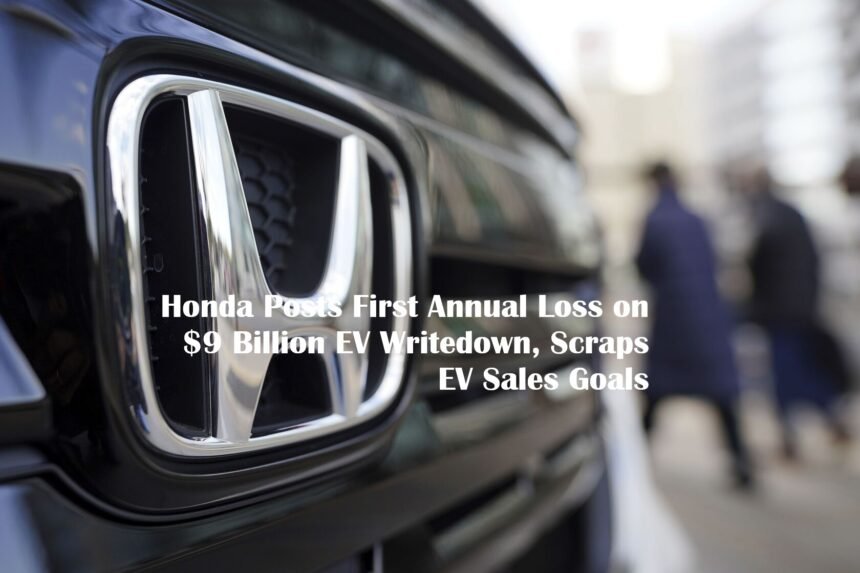
Reuters reported that Honda Motor recorded its first annual loss since becoming a publicly traded company in 1957. The Japanese automaker faced a major financial setback after a massive writedown tied to its electric vehicle business. The company also abandoned several long-term electric vehicle sales goals as global demand slowed.
Honda’s latest earnings report highlights the growing pressure on traditional automakers. Many companies invested heavily in electric vehicles in recent years. However, consumer demand has not expanded as quickly as expected. Rising production costs and weaker sales have created serious challenges across the industry.
Honda Suffers Historic Financial Loss
Honda reported an operating loss of 414.3 billion yen for the fiscal year ending in March. A year earlier, the company had posted a profit of 1.2 trillion yen. The sharp reversal marked one of the biggest financial declines in Honda’s history. The loss was mainly caused by a 1.45 trillion yen charge related to electric vehicle restructuring.
Honda previously warned investors that EV-related costs could climb even higher. The company had prepared for writedowns of up to 2.5 trillion yen before final results were released. Industry analysts believe Honda expanded its EV plans too aggressively.
Large investments were made while demand remained uncertain in several key markets. Consumers also continued choosing hybrid vehicles instead of fully electric models.
The weak performance reflects a wider issue affecting many global carmakers. Companies expected EV adoption to accelerate quickly after government incentives and environmental regulations increased. Instead, buyers in several regions became more cautious because of high vehicle prices and charging concerns.
Honda Abandons Major EV Targets
Honda also scrapped important long-term electric vehicle goals. Chief Executive Toshihiro Mibe announced that the company no longer expects EVs to account for 20% of new vehicle sales by 2030. Another target involving a complete transition to electric and fuel-cell vehicles by 2040 was also dropped. The decision signals a major strategic shift for the company.
Honda had previously promoted ambitious electrification plans to compete with rivals in North America, Europe, and China. Those plans now appear less realistic under current market conditions. Many automakers are revising EV timelines as consumer demand slows. High borrowing costs and expensive battery production continue to hurt profitability.
In some regions, charging infrastructure also remains underdeveloped. Honda’s management now appears focused on balancing investment risks with financial stability. Executives emphasized the need for careful spending while maintaining long-term competitiveness.
Canada EV Project Suspended
Honda also suspended its planned EV and battery investment project in Canada. The project carried an estimated value of $11 billion and represented one of Honda’s largest overseas investments. The suspension reflects broader uncertainty within the electric vehicle sector.
Several global manufacturers have delayed battery factories and EV expansion plans during the past year. Investors increasingly demand stronger profitability instead of rapid expansion. The Canadian project was expected to support North American EV production.
However, slowing market growth forced Honda to reconsider the timing of the investment. Government support for electric vehicles remains strong in many countries. Still, automakers face mounting pressure to control costs while adapting to changing consumer behavior.
Motorcycle Business Helps Honda Recover
Despite the historic loss, Honda still expects a return to profitability during the current fiscal year. The company forecasts a profit of 500 billion yen through cost-cutting measures and stronger motorcycle sales. Honda’s motorcycle division continues delivering strong financial performance. Record sales were achieved in India and Brazil during the last fiscal year.
The business generated enough cash flow to offset part of the EV-related losses. The motorcycle segment remains one of Honda’s most valuable assets. Strong demand in emerging markets continues to support revenue growth. Affordable transportation options remain attractive in regions with expanding urban populations.
Honda plans to increase motorcycle production capacity in India. The company expects annual sales to reach 22.8 million units. However, analysts also warned that electric motorcycle competition could intensify in countries such as India and Vietnam. Local manufacturers continue developing cheaper electric alternatives for urban riders.
Investors React Positively
Honda’s share price rose 3.8% after the earnings announcement. Investors responded positively because the company maintained its dividend and promised large shareholder returns. Honda pledged at least 800 billion yen in shareholder returns over the next three years.
The company also kept its annual dividend at 70 yen per share. The positive market reaction suggests investors still trust Honda’s long-term financial position.
Many shareholders viewed the restructuring costs as a necessary adjustment rather than a permanent crisis. Analysts also noted that Honda’s financial challenges differ from those of some rivals because of the company’s strong motorcycle business. The division provides stable earnings even when automotive profits weaken.
Rising Costs Continue Creating Pressure
Honda warned that higher material costs could hurt profits during the current fiscal year. Executives cited global supply chain risks and geopolitical tensions as major concerns. The company estimated that rising costs could reduce operating profit by 313 billion yen. Battery materials remain especially expensive across the automotive industry.
Prices for lithium and other key resources increased sharply during recent years. Automakers continue searching for ways to reduce production costs while maintaining vehicle quality. Competition in China also remains intense. Domestic Chinese brands continue gaining market share with lower-priced electric models.
Foreign automakers face increasing pressure to adapt their pricing strategies. Honda now appears focused on a more cautious growth strategy. The company aims to protect profitability while gradually expanding electrification efforts.
Future Outlook for Honda
Honda’s financial results reveal the growing difficulties facing traditional automakers during the transition toward electric mobility. Aggressive investment strategies created significant risks as consumer demand slowed. The company still plans to develop electric vehicles, but future investments will likely become more selective.
Honda’s leadership now appears determined to balance innovation with financial discipline. Strong motorcycle sales and shareholder support may help Honda recover during the coming years.
However, the company must still navigate rising costs, global competition, and uncertain EV demand. Honda’s experience could also influence how other automakers approach electric vehicle expansion in the future.