



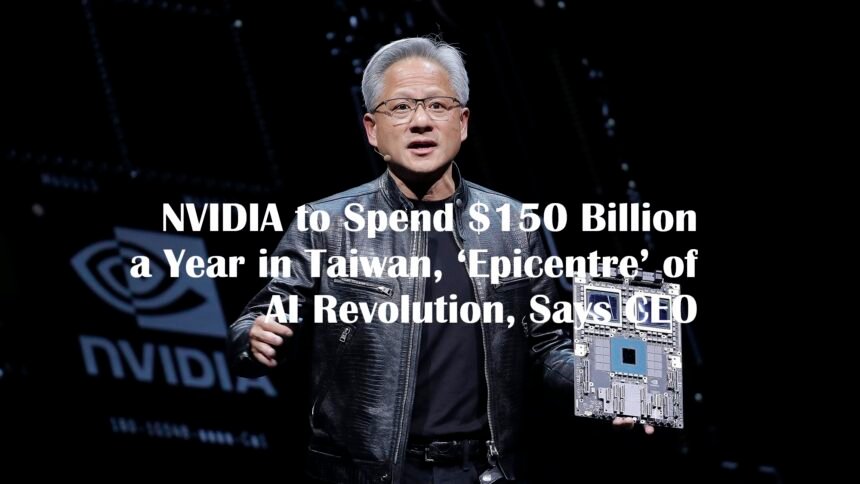
Taiwan continues to play a major role in the global technology industry. The island now stands at the center of the artificial intelligence boom. NVIDIA CEO Jensen Huang recently highlighted Taiwan’s importance during discussions about future investments and AI development.
Huang stated that Nvidia could spend as much as $150 billion annually in Taiwan. The company plans to deepen cooperation with suppliers and manufacturing partners across the region. His comments showed strong confidence in Taiwan’s technology ecosystem and production capabilities.
Global demand for AI chips keeps growing rapidly. Major technology companies race to build advanced systems that support generative AI, cloud computing, robotics, and automation. NVIDIA currently leads much of that market through its powerful graphics processing units and AI hardware.
Taiwan has become essential to those ambitions. The island hosts many of the world’s most advanced semiconductor manufacturers. Companies there produce chips that power modern data centers, smartphones, and AI systems.
NVIDIA Expands Its AI Vision
NVIDIA experienced massive growth during the AI surge. The company transformed from a gaming hardware producer into one of the world’s most valuable technology firms. Its processors now support advanced AI models across many industries.
Jensen Huang described Taiwan as the “epicentre” of the AI revolution. He praised the region’s engineering talent, manufacturing expertise, and supply chain efficiency. NVIDIA relies heavily on partnerships in Taiwan to meet global demand.
The company expects AI adoption to accelerate further during the coming years. Businesses continue investing heavily in machine learning tools and high-performance computing infrastructure. Governments also support AI expansion through research funding and digital transformation projects.
NVIDIA’s growing investment reflects confidence in long-term demand. The company believes AI technology will influence healthcare, education, transportation, manufacturing, and entertainment. More organizations now integrate AI tools into daily operations.
Taiwan’s Semiconductor Industry Gains More Attention
Taiwan already dominates advanced chip manufacturing. Semiconductor companies there produce some of the most sophisticated processors in the world. Many global technology firms depend on those facilities.
The AI boom increased the strategic value of Taiwan’s chip sector. Demand for advanced semiconductors continues to climb as AI models become larger and more complex. Data centers require enormous computing power to train and operate those systems.
NVIDIA works closely with manufacturing partners to secure enough production capacity. Strong relationships with Taiwanese suppliers help the company maintain its market position. Efficient production also allows faster delivery to global customers.
Industry experts believe Taiwan’s role could grow even further. AI infrastructure requires constant innovation in chip design and manufacturing processes. Taiwan’s semiconductor ecosystem supports that rapid development.
Global Competition in AI Intensifies
Technology companies worldwide compete aggressively in the AI race. Firms invest billions of dollars into data centers, processors, and cloud infrastructure. Countries also view AI leadership as an economic and strategic priority.
The United States and China continue competing for influence in advanced technology sectors. Semiconductor production became a major focus in that rivalry. Governments now support domestic manufacturing and supply chain security initiatives.
Taiwan sits at the center of those global dynamics. The island’s semiconductor industry connects directly to major technology companies worldwide. Any disruption in production could affect industries across multiple continents.
NVIDIA’s investment plans underline the importance of stable supply chains. Reliable chip manufacturing remains essential for future AI expansion. Companies seek stronger partnerships to reduce operational risks and secure long-term production.
AI Demand Continues to Surge
Artificial intelligence now influences many parts of modern life. Businesses use AI tools to improve efficiency, analyze data, and automate tasks. Consumers interact with AI through search engines, digital assistants, and recommendation systems. Large language models require powerful processors and enormous computing resources.
NVIDIA supplies many of the chips that support those systems. As AI applications grow, demand for advanced hardware increases as well. Cloud service providers continue expanding data center capacity. Technology giants purchase thousands of AI processors to support growing workloads.
That demand helped Nvidia achieve record financial performance in recent years. Analysts expect the AI market to expand significantly during the next decade. Healthcare companies explore AI-powered diagnostics. Automotive firms develop autonomous driving technologies.
Financial institutions also integrate machine learning into operations. Taiwan’s semiconductor sector stands ready to benefit from those trends. Local manufacturers continue increasing production capacity and investing in advanced facilities.
Jensen Huang Highlights Taiwan’s Importance
Jensen Huang maintains strong connections with Taiwan. He often praises the island’s contribution to global technology innovation. During recent appearances, he emphasized the collaboration between Nvidia and Taiwanese companies. Huang noted that Taiwan offers a unique combination of talent, precision manufacturing, and supply chain coordination.
Those advantages support rapid development and large-scale chip production. The Nvidia CEO also pointed to the broader transformation created by AI. He described artificial intelligence as a technological shift similar to the industrial revolution or the rise of the internet.
According to Huang, AI will reshape nearly every industry. His comments attracted significant attention across financial and technology markets. Investors continue watching Nvidia closely because it influences the global AI economy.
Economic Benefits for Taiwan
NVIDIA’s expanding investment could bring major economic benefits to Taiwan. Increased spending may create jobs, strengthen supplier networks, and encourage further technology investment. Local companies involved in semiconductor manufacturing may experience stronger growth opportunities.
Equipment suppliers, engineering firms, and logistics providers could also benefit from increased activity. Taiwan’s government continues to support technology innovation through infrastructure and education initiatives.
Officials aim to maintain the island’s leadership position in semiconductor production and advanced computing. Foreign investment also strengthens Taiwan’s role in global technology supply chains. International companies increasingly depend on Taiwanese expertise for high-performance chip manufacturing.
Challenges Remain Despite Optimism
Despite strong growth, challenges still exist within the semiconductor industry. Geopolitical tensions create uncertainty for global markets. Trade restrictions and export controls continue to affect technology companies. Supply chain disruptions also remain a concern. Semiconductor production requires highly specialized equipment and materials.
Delays in one area can affect manufacturing timelines across the industry. Energy demands present another challenge. AI data centers consume massive amounts of electricity.
Technology companies now explore cleaner energy solutions and more efficient computing systems. Competition within the AI market also continues to intensify. Rival chipmakers invest heavily in new technologies to challenge Nvidia’s dominance. Companies race to produce faster and more efficient processors.
The Future of AI and Taiwan
The AI revolution continues transforming the global economy. NVIDIA’s planned spending in Taiwan highlights the island’s central role in that transformation. Advanced semiconductor manufacturing now supports the foundation of modern artificial intelligence.
Taiwan’s technology ecosystem remains critical for future innovation. Strong partnerships between Nvidia and Taiwanese companies could shape the next generation of AI infrastructure.
Global demand for computing power shows little sign of slowing down. Businesses, governments, and consumers continue to adopt AI technologies at a rapid pace. That momentum may drive even larger investments in semiconductor production during the years ahead.
NVIDIA’s commitment signals confidence in Taiwan’s future as a global technology leader. As AI expands across industries, Taiwan will likely remain one of the most important centers of innovation and advanced manufacturing in the world.