



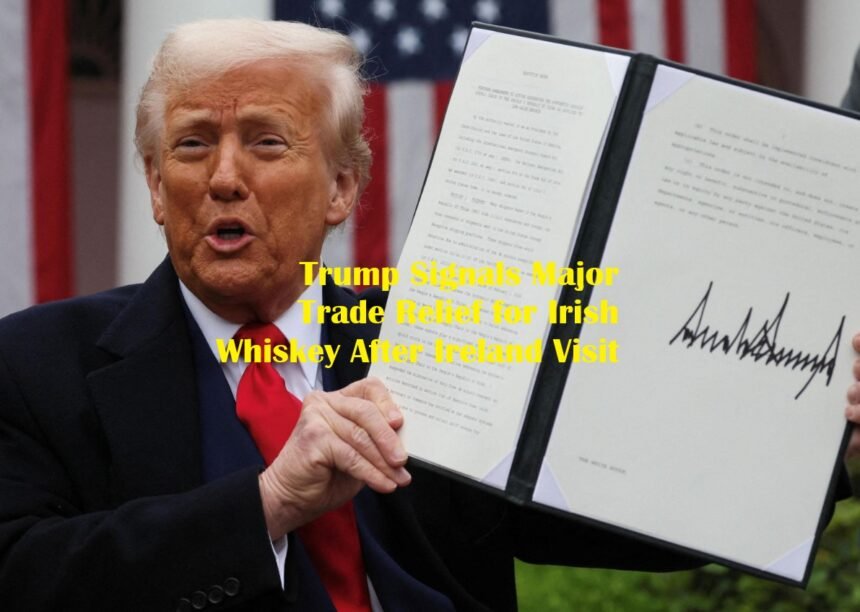
The U.S. alcohol market could soon become more favorable for Irish whiskey producers after President Donald Trump announced plans to eliminate a 10% tariff on whiskey imported from Ireland. Trump made the announcement Sunday while presenting the Irish Open trophy at his golf resort in Doonbeg, Ireland.
He said Irish Prime Minister Micheál Martin, golfer Shane Lowry and others had repeatedly asked him to remove the tariff, prompting him to promise that the United States would take the duty off Irish whiskey. The announcement could provide relief to an industry that relies heavily on American consumers. It also represents another example of Washington selectively adjusting tariffs after imposing broad trade measures on imports.
Irish Whiskey Has a Major Stake in the U.S. Market
The significance of the decision becomes clearer when considering the size of the American market for Irish whiskey. Ireland exports roughly €450 million, or about $520 million, worth of whiskey to the United States each year. The American market accounts for approximately one-third of global Irish whiskey sales, making the U.S. particularly important for distillers and producers based in Ireland. A 10% import charge can affect the economics of that trade in several ways.
Importers may absorb part of the additional expense, distributors can face tighter margins, and retailers may ultimately pass some of the cost to customers. Removing the duty could therefore improve pricing flexibility throughout the supply chain. For American businesses that distribute and sell Irish whiskey, the policy change could also reduce uncertainty surrounding future inventory and pricing decisions.
Washington Had Already Reduced the Tariff
The latest announcement follows several changes to U.S. tariff policy affecting alcoholic beverages. Irish whiskey had been subject to a 15% tariff before the rate was reduced to 10% under changes associated with the broader U.S.-European Union trade framework. The lower rate nevertheless left Irish whiskey facing an additional cost in the American market.
The situation also created an uneven environment within the whiskey industry. The Trump administration had already removed tariffs on whiskey produced in the United Kingdom, including Scotch whisky. That decision meant Irish producers continued to face a duty while one of their major competitors received preferential treatment. Removing the Irish tariff would narrow that gap and potentially create a more balanced competitive environment.
Trump Made the Announcement During His Ireland Visit
The timing of Trump’s statement was closely connected to his visit to Ireland. The president attended the Irish Open at his Trump International Golf Links property in Doonbeg. During the trophy ceremony, he said he had discussed the tariff issue with Martin and that Lowry had also raised the matter.
The announcement received an enthusiastic response from the crowd. Trump also emphasized the broader relationship between Washington and Dublin during the visit. The whiskey decision consequently offered an economic element to a trip that also attracted significant attention because of the president’s comments about Irish reunification.
Industry Groups Welcome the Potential Change
Irish whiskey representatives have previously argued that eliminating the tariff would benefit both sides of the Atlantic. The Irish Whiskey Association welcomed Trump’s announcement, describing the U.S. market as essential to the industry’s international business. The group has also advocated for returning to a zero-tariff environment for beverage exports between Ireland and the United States. American alcohol industry representatives likewise see potential benefits.
Lower import costs could support distributors, hospitality companies and retailers that depend on imported spirits. The Distilled Spirits Council of the United States said removing the tariff could help American businesses and consumers, particularly ahead of the important holiday sales season.
Implementation Details Remain Unclear
Despite Trump’s announcement, several practical questions remain unanswered. The White House and U.S. trade officials had not immediately provided a detailed timetable for when the tariff would officially disappear. Trump also indicated that the decision was specifically intended to apply to Irish whiskey rather than representing a broader removal of tariffs on European Union spirits. That distinction is important because the move does not necessarily signal a fundamental reversal of the administration’s wider tariff strategy.
Instead, it appears to be a targeted concession involving a specific product and trading partner.
A Small Product With a Larger Trade Message
Irish whiskey may represent only one category within the enormous U.S.-Ireland trading relationship, but Trump’s decision carries a broader message about the administration’s tariff approach. The move shows that duties can be adjusted when economic, political or diplomatic considerations change.
For Irish producers, the immediate priority is restoring predictable access to their largest export market. If the 10% tariff is formally removed, Irish whiskey companies could gain improved access to American consumers while U.S. importers and retailers receive greater flexibility. The decision therefore goes beyond a tax on one type of alcoholic beverage. It demonstrates how quickly tariff policy can affect international supply chains, competitive pricing and relationships between trading partners.